
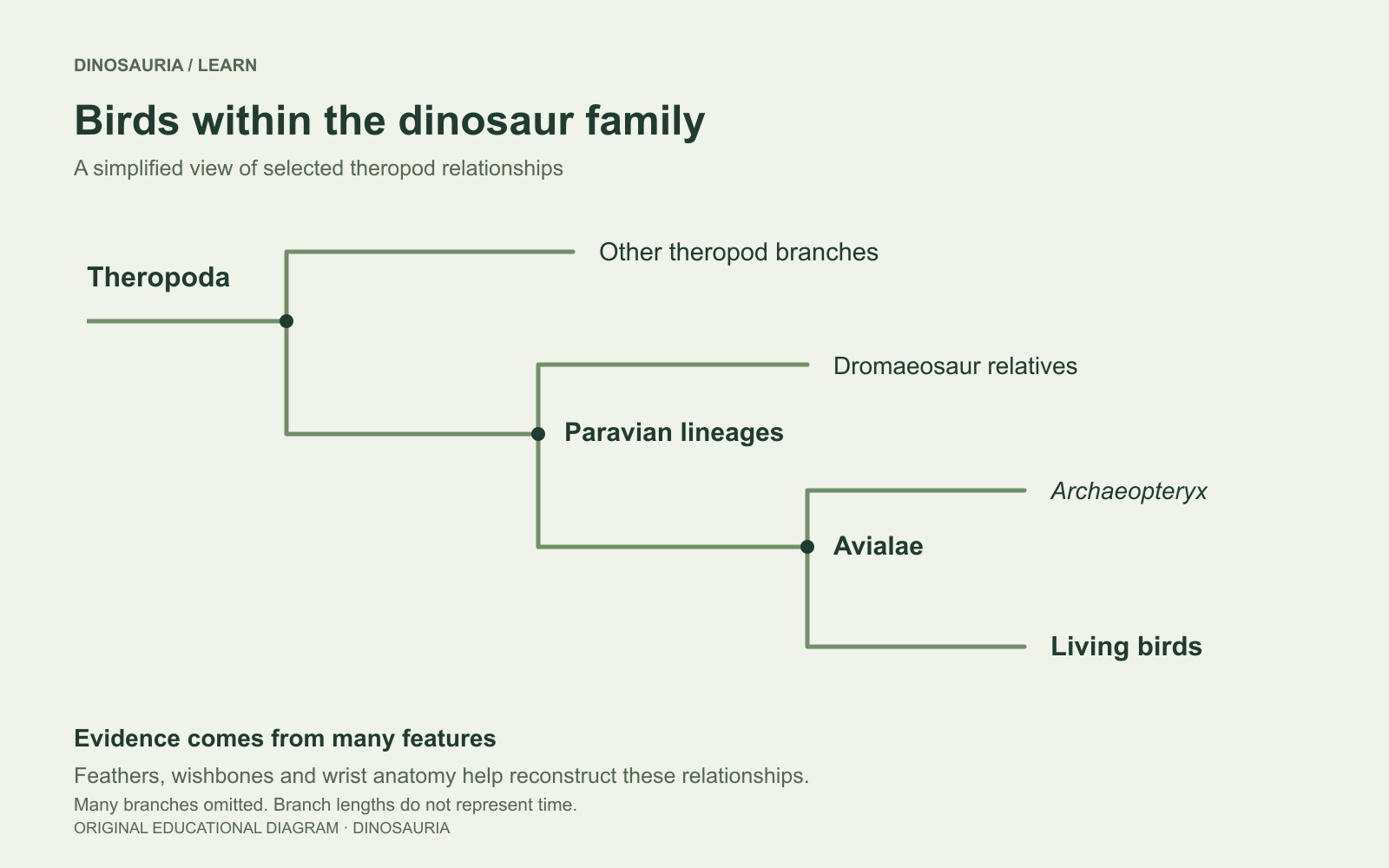
Yes. Birds evolved within the theropod branch of dinosaurs, and they remain members of that branch today. A gull and a Tyrannosaurus share dinosaur ancestry, although the gull did not descend from Tyrannosaurus itself. Their lineages connect farther back in the family tree. The evidence comes from many fossils and anatomical comparisons that link birds with other theropods. [1]
An ancestry recorded in bones
Birds share a suite of features with their theropod relatives, including the wishbone, aspects of the wrists and shoulders, and many details of the skeleton. Some familiar avian traits appeared before the first birds. Researchers study how these features are distributed across fossil animals to reconstruct their sequence of acquisition. The bird body plan was assembled through evolutionary changes, rather than arriving all at once. [1][2]
This matters because one resemblance can be misleading. Wings occur in bats, pterosaurs and birds, yet those wings evolved along separate histories. The case for birds as dinosaurs rests on a coherent pattern of shared features and branching relationships. It also explains why some small, feathered dinosaurs look difficult to place using everyday categories. Evolution need not respect the sharp visual boundaries we expect from familiar living animals.
Feathers came before modern birds
Fossils preserve feathers in dinosaurs outside the bird branch, including forms unable to fly. Feather structures range from relatively simple filaments to complex vaned feathers. Their distribution shows that feathers did not originate solely as equipment for modern bird flight. Insulation and display are among the proposed earlier functions, although the role of a particular covering depends on the animal and the evidence preserved. [3]
A feathered fossil does not therefore automatically represent a bird. Nor does it show that all dinosaurs carried the same kind of feathers. Different lineages had different coverings, and soft tissues preserve less consistently than bones. Reconstructing an animal requires attention to what is directly visible in its fossils and what is inferred from close relatives. A scientifically useful illustration should make that distinction clear.
Archaeopteryx and a mosaic of features
Archaeopteryx lived around 150 million years ago, during the Late Jurassic. Its fossils combine well-developed feathers with a long bony tail, teeth and clawed fingers. Such a combination makes it valuable for understanding early avian evolution. It illustrates how features associated with living birds coexisted with traits inherited from other dinosaurs. [4]
That does not require Archaeopteryx to be the direct ancestor of every living bird. A close relative near an evolutionary transition can reveal an informative body plan while occupying a side branch. Fossils often document these neighbouring lineages more readily than a continuous sequence of direct ancestors. Their scientific importance lies in the evidence they preserve, rather than a guaranteed position in a pedigree.
A smaller body and changing proportions
One influential analysis found sustained reduction in body size along the lineage leading toward birds, over tens of millions of years. Miniaturization accompanied anatomical innovation and may have opened ecological opportunities unavailable to larger relatives. It was part of a broader transformation involving balance, forelimbs and other features. This is a trend along a particular evolutionary path, not a statement that all dinosaurs gradually shrank. [5]
Another study found that the distinctive avian body plan emerged through accumulated changes among theropods, followed by rapid evolution near the origin of birds. Together, these results help explain why the boundary between an early bird and a close non-avian relative can be anatomically subtle. Classification identifies branches in a continuous history; it does not imply that a parent population suddenly produced a fully modern bird. [2]
Flight was a separate evolutionary problem
The origin of birds and the origin of powered flight are closely related questions, but they are not identical. Feathers, aerodynamic surfaces, body size and shoulder mechanics all matter. Fossil relatives reveal different combinations of these features, including animals with feathered limbs that may have used aerial movement differently from living birds. Researchers continue to investigate which animals could glide, flap or sustain powered flight. [4]
A useful account avoids a single cinematic moment in which a dinosaur decides to take to the air. Structures that evolved under one set of conditions can later contribute to a new function. Natural selection acts on inherited variation in each generation; it cannot anticipate a future flying animal. Several related lineages experimented, in an evolutionary sense, with forms of aerial locomotion. Their histories do not fit a simple straight progression.
Birds lived alongside other dinosaurs
Early birds shared Mesozoic ecosystems with many non-avian dinosaurs. By the time Tyrannosaurus lived near the end of the Cretaceous, avian evolution already had a long history. The mass extinction about 66 million years ago eliminated non-avian dinosaurs and many bird lineages too. A surviving subset of birds gave rise to the diversity alive today. It is misleading to suggest that every ancient bird lineage survived. [1][6]
The distinction between avian and non-avian dinosaurs helps describe that event. It also changes the meaning of a familiar question. Dinosaurs did suffer a devastating extinction, but Dinosauria as a whole did not disappear. Its surviving branch now includes animals as different as hummingbirds, ostriches and penguins. Flight is not required for membership: a penguin or an ostrich remains a bird and a dinosaur.
Seeing the living connection
When you look at a bird, you are seeing one specialized outcome of dinosaur evolution. Its feathered wings and compact body differ greatly from those of many fossil relatives, yet evolutionary change does not erase ancestry. The same nested relationship allows a bird to belong to Theropoda, Dinosauria and the wider archosaur group simultaneously.
A cladogram makes the connection visible. Find the bird branch and follow it back through its shared junctions with other theropods. Those junctions express common ancestry, not a claim that a familiar fossil predator turned directly into a modern species. The answer to whether birds evolved from dinosaurs is yes; the richer insight is that their descendants remain dinosaurs around us.
Continue exploring
- What Is a Dinosaur?
- The Dinosaur Family Tree: Understanding Dinosaur Evolution
- Saurischia vs Ornithischia
- The Rise of Tyrannosaurs
- When Did Dinosaurs Live? The Triassic, Jurassic and Cretaceous Explained
- Dinosauria Glossary
- How Did Dinosaurs Get So Big?
- Velociraptor and Its Relatives: Beyond Jurassic Park
- How Do We Know What Dinosaurs Looked Like?
- Why Did Dinosaurs Go Extinct?
Sources & further reading
- Brusatte, O'Connor and Jarvis. 2015. The Origin and Diversification of Birds. (Current Biology (2015))
- Brusatte et al. 2014. Gradual assembly of avian body plan culminated in rapid rates of evolution across the dinosaur-bird transition. (Current Biology (2014))
- AMNH. Figuring Out Feathers. (American Museum of Natural History)
- Natural History Museum. How did birds and other dinosaurs learn to fly? (Natural History Museum)
- Lee et al. 2014. Sustained miniaturization and anatomical innovation in the dinosaurian ancestors of birds. (Science (2014))
- Natural History Museum. When did dinosaurs live? (Natural History Museum)