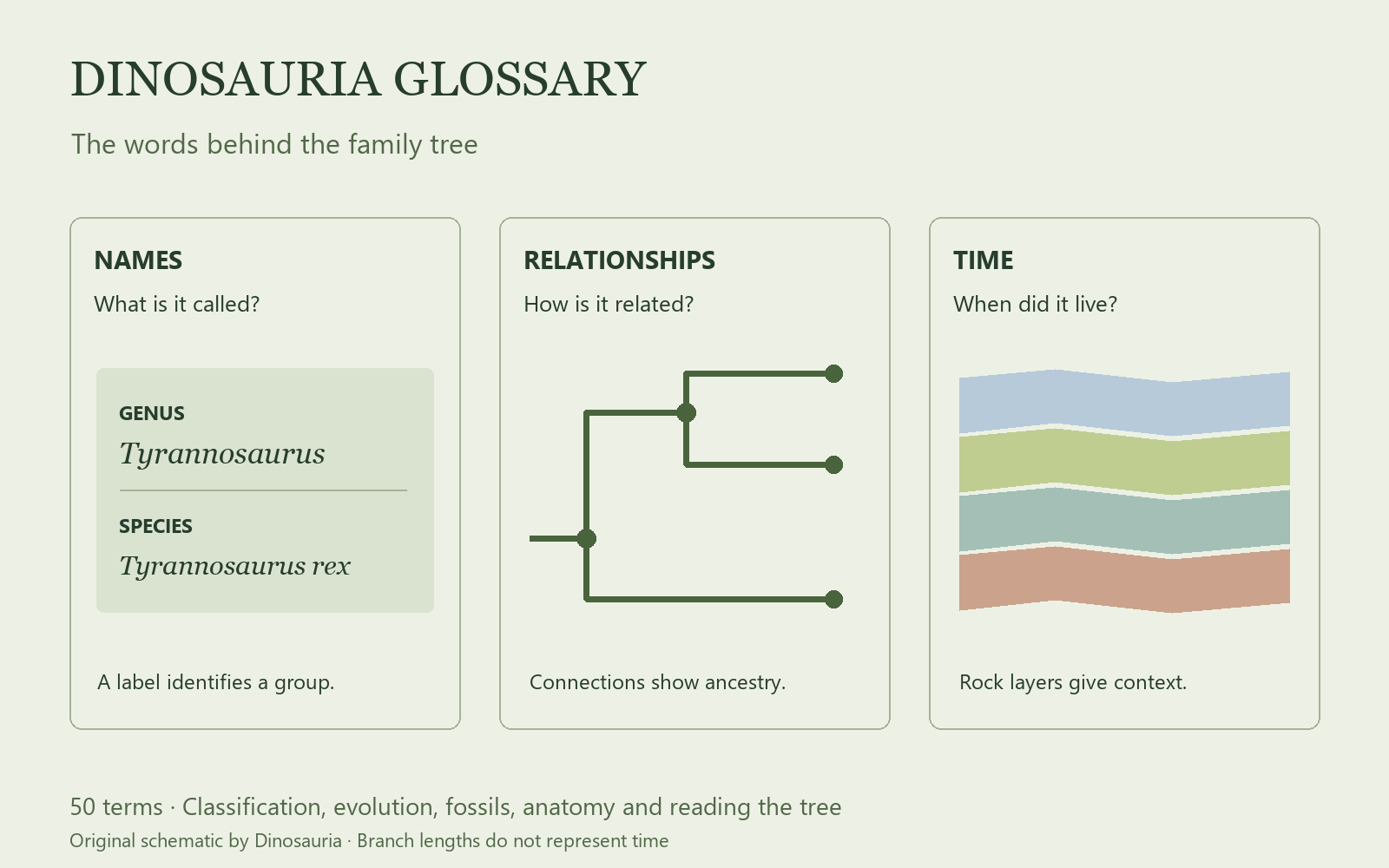
A dinosaur name can tell you what an animal is called, a branch can suggest its relationships, and a rock layer can help place it in time. Those are different kinds of information. This dinosaur glossary brings together 50 terms used in paleontology and in the Dinosauria explorer, grouped so you can read a section or look up a single word.
Start with What Is a Dinosaur? for an introduction, or keep this guide beside The Dinosaur Family Tree. Definitions summarize scientific usage; disputed relationships and incomplete fossils mean some interpretations can change. The tree presents the arrangement of its source spreadsheet, rather than a new analysis that resolves every debate.
Classification and taxonomy
These terms describe names and groups. A named group can contain many smaller groups; a rank does not measure how old or diverse it is. [1]
- Taxonomy
- The work of identifying, naming and classifying organisms. Dinosaur taxonomy connects names with specimens and group definitions; it can change when new evidence alters which fossils belong together. [1]
- Taxon (plural: taxa)
- A named or recognized group of organisms at any level of classification. A species, genus or larger group can be a taxon; the word does not specify a rank. [1]
- Species
- A basic unit of biological classification. Fossil species are commonly distinguished using anatomical evidence because breeding relationships cannot usually be tested. Different species concepts can produce different boundaries. [1]
- Genus (plural: genera)
- A taxonomic rank grouping one or more species. Tyrannosaurus is a genus; Tyrannosaurus rex is a species within it. A genus name alone is not a complete species name. [1]
- Binomial name
- The two-part scientific name of a species: genus followed by a specific epithet. In Tyrannosaurus rex, the genus starts with a capital, rex is lowercase, and both words are italicized. [1]
- Family
- A rank above genus in traditional classification. Dinosaur family names commonly end in -idae, as in Tyrannosauridae. Families can differ greatly in their age and number of included species. [2]
- Dinosauria
- The evolutionary group containing birds and the extinct animals recognized as dinosaurs, including Tyrannosaurus and Triceratops. Membership follows ancestry, not size or ferocity. Pterosaurs and mosasaurs fall outside Dinosauria. [3]
- Non-avian dinosaur
- A dinosaur outside the bird group. This useful phrase distinguishes extinct dinosaurs such as Stegosaurus from birds, which remain dinosaurs. See Did Birds Evolve from Dinosaurs?. [3]
Evolution and cladistics
Evolutionary trees are testable explanations of relationships. Many characters are compared together; a single resemblance rarely settles the question. [4]
- Evolution
- Change in inherited characteristics of populations across generations: descent with modification. Evolution can produce branching lineages; it does not require every lineage to become larger, more complex or more like humans. [2]
- Phylogeny
- The evolutionary history and relationships of a group. A phylogenetic tree represents a hypothesis about that history, inferred from evidence; it is not a direct observation of every ancestral population. [2]
- Cladistics
- An approach to reconstructing relationships by comparing inherited characters, especially shared derived states. Analyses evaluate patterns across taxa rather than arranging animals by their overall appearance or their geological age alone. [4]
- Clade (monophyletic group)
- A common ancestor and all its descendants. A clade may contain other clades: birds sit within theropods, which sit within Dinosauria. Descendants retain membership even when their appearance changes dramatically. [2]
- Common ancestor
- An ancestral population or organism shared by two or more lineages. Their most recent common ancestor is the latest one they share; it is usually inferred rather than identified as a particular fossil. [2]
- Sister groups
- Two lineages that share an immediate common ancestor in a particular tree. Each is the other's closest relative among the groups shown; adding taxa or revising the analysis can change the displayed pairing. [4]
- Synapomorphy
- A shared derived character state that supports a clade. Derived means changed relative to an ancestral condition in the comparison; it does not mean superior, and later descendants may modify or lose the feature. [4]
- Homology
- Similarity inherited from common ancestry. A bird's wing bones and a theropod's forelimb bones can be compared as homologous structures even though their proportions and functions differ. [4]
- Convergent evolution
- Independent evolution of similar features in separate lineages. Similar feeding tools or body shapes can reflect similar challenges rather than especially close kinship, which is why researchers compare many characters. [4]
Geological time
The dates below use rounded boundaries from the December 2024 ICS chart, matching When Did Dinosaurs Live?. Numerical age estimates can be revised; geological units are not dinosaur groups. [6]
- Ma (million years ago)
- A geological age expressed in millions of years before the present. A fossil dated to 150 Ma is about 150 million years old. An age is different from the duration of an interval.
- Era
- A major division of geological time containing periods. The Mesozoic is an era; the Triassic, Jurassic and Cretaceous are its periods. These names organize time rather than imply identical worldwide environments. [6]
- Period
- A subdivision of an era, itself divided into epochs. Saying that two dinosaurs are Jurassic gives a broad time address; closer dating and geography are needed to establish whether they could have met. [6]
- Mesozoic
- The era from about 252 to 66 Ma, comprising the Triassic, Jurassic and Cretaceous. It includes most familiar non-avian dinosaur history, but dinosaurs appeared after its beginning and birds survived its end. [6]
- Triassic
- The period from about 252 to 201 Ma. The earliest well-supported dinosaurs occur in its later part; the beginning of the Triassic is not the date when dinosaurs first appeared. [6][7]
- Jurassic
- The period from about 201 to 143 Ma on the chart used here. Stegosaurus and Archaeopteryx lived during the Late Jurassic; Tyrannosaurus rex lived much later, in the Cretaceous. [6][7]
- Cretaceous
- The period from about 143 to 66 Ma on the chart used here. It ended with the extinction of all non-avian dinosaurs. Older references often place its beginning near 145 Ma. [6][7]
- K–Pg boundary
- The Cretaceous–Paleogene boundary, about 66 Ma, marking a mass extinction and the start of the Cenozoic Era. Birds already existed before this event; some bird lineages survived it. [7]
Fossils and paleontology
Fossils preserve different kinds of evidence. A skeleton, a footprint and the surrounding sediment can answer different questions about an ancient animal. [8]
- Paleontology (palaeontology)
- The scientific study of past life through fossils and their geological context. It covers far more than dinosaurs, including ancient plants and microorganisms, and differs from archaeology, which studies human history. [8]
- Fossil
- Preserved evidence of past life, including remains and traces of activity. Fossils need not be complete skeletons or original bone; impressions and mineral-altered remains also preserve biological information. [8]
- Body fossil
- Evidence of an organism's body, such as a bone, tooth, shell or leaf. It can include an impression or mineral replacement of the body part, rather than unchanged original material. [9]
- Trace fossil
- Evidence of biological activity, such as a footprint, trackway, burrow or coprolite. A dinosaur track can reveal movement without preserving its maker's skeleton; identifying the exact species is often difficult. [8]
- Coprolite
- Fossilized dung. Contents may provide clues to diet and food webs, but identifying the producer requires supporting evidence. Finding plant fragments or bones inside does not automatically identify a particular dinosaur species. [9]
- Holotype
- The single specimen designated as the name-bearing reference when a species is established. It need not be complete or typical in every feature; other specimens help researchers understand the species' variation. [10]
- Taphonomy
- The study of processes affecting remains from death through preservation and discovery, including decay, transport and burial. These processes help explain why a fossil assemblage is an incomplete, altered sample of an ecosystem. [11]
- Stratigraphy
- The study of rock layers and their relationships. A fossil's position within those layers helps establish relative age and context; numerical dating and correlations provide additional constraints. Older layers normally underlie younger ones in undisturbed sequences. [12]
Anatomy and biology
Anatomical terms describe structures; biological terms describe how organisms live. Neither automatically identifies an evolutionary group. For the historical hip names, see Saurischia vs Ornithischia. [3]
- Bipedal
- Moving on two limbs, normally the hindlimbs in dinosaurs. Birds and many non-avian theropods are bipedal. Walking on two legs alone does not establish that an animal belongs to Dinosauria.
- Quadrupedal
- Moving on four limbs. Adult sauropods and many ornithischians were quadrupedal. Posture and locomotion can change within a lineage and during growth, so they should be interpreted in anatomical context.
- Pelvis
- The hip region linking the hindlimbs to the vertebral column. Its main paired bones are the ilium, ischium and pubis. Their arrangement helps describe dinosaur anatomy but does not alone settle relationships.
- Pubis
- One of the three main bones on each side of the pelvis. Its orientation inspired the historical names lizard-hipped and bird-hipped. Birds belong within theropods despite their backward-directed pubis.
- Vertebra (plural: vertebrae)
- An individual element of the backbone. Vertebrae differ along the neck, trunk, hip region and tail; their shapes and internal structures can provide evidence about relationships, movement and air-filled spaces.
- Feathers
- Skin structures best known in birds, with fossil evidence also found in non-avian dinosaurs. Feathers did not originate solely for modern flight; their forms and functions varied among lineages. [13]
- Herbivory
- Feeding on plants. Teeth, jaws, wear and gut contents can support an inference of herbivory, but usually cannot reveal every food an extinct animal ate. It is a feeding strategy, not a clade.
- Carnivory
- Feeding on animals, whether obtained by hunting, scavenging or both. Sharp teeth alone do not establish a complete feeding ecology. Theropoda includes birds and other lineages with varied diets, rather than only large predators.
Reading the Dinosauria tree
Use the branching connections to follow nested groups. The explorer's card spacing is a layout choice, and its source arrangement should not be mistaken for a complete statement of scientific certainty. [5]
- Cladogram
- A diagram emphasizing branching relationships. Its branch lengths do not inherently measure time or evolutionary change. In Dinosauria, use geological information separately from the visual distance between cards. [14]
- Node
- A point on a tree. In evolutionary diagrams, internal branching nodes generally represent inferred common ancestors. A Dinosauria card may instead label an entire named group; an unnamed junction is not a newly named taxon. [14]
- Branch
- A connection representing a lineage in an evolutionary tree. Follow connected branches to compare ancestry; screen proximity between labels does not establish relatedness, and rotating a branching diagram need not change its meaning. [5]
- Root
- The base of a rooted tree, representing the common ancestry of the groups included. A tree rooted on dinosaurs starts within a much larger history of life; it does not show the origin of all organisms. [14]
- Tip (terminal taxon)
- An endpoint in the displayed tree. A tip may stand for a species or a larger group and can be extinct or living. A collapsed card can hide descendants without becoming a biological endpoint. [5]
- Nested groups
- Groups contained within larger groups. A bird can belong to Aves, Theropoda and Dinosauria at once. Expanding a group reveals more of that hierarchy; it does not turn one named animal into another. [13]
Explore these taxa in the tree
Continue exploring
- What Is a Dinosaur?
- The Dinosaur Family Tree: Understanding Dinosaur Evolution
- Saurischia vs Ornithischia
- Did Birds Evolve from Dinosaurs?
- The Rise of Tyrannosaurs
- When Did Dinosaurs Live? The Triassic, Jurassic and Cretaceous Explained
- How Did Dinosaurs Get So Big?
- Velociraptor and Its Relatives: Beyond Jurassic Park
- How Do We Know What Dinosaurs Looked Like?
- Why Did Dinosaurs Go Extinct?
Sources & further reading
- What is taxonomy? (Natural History Museum)
- Glossary: Phylogenetics (University of California Museum of Paleontology)
- What are dinosaurs? (Natural History Museum)
- Journey into Phylogenetic Systematics (University of California Museum of Paleontology)
- Aspects of phylogenies: topology (EMBL-EBI)
- International Chronostratigraphic Chart, December 2024 (rounded ages used here) (International Commission on Stratigraphy)
- When did dinosaurs live? (Natural History Museum)
- What is a fossil? (National Park Service)
- Fossil preservation (University of Colorado Museum of Natural History)
- Fossil type specimens in parks (National Park Service)
- How fossils form (National Park Service)
- Glossary: Geology (University of California Museum of Paleontology)
- How dinosaurs evolved into birds (Natural History Museum)
- Aspects of phylogenies: nodes (EMBL-EBI)