
A map of relationships
A dinosaur family tree is a scientific model of evolutionary relationships. It connects groups through shared ancestry. Unlike a family chart of named parents and children, it usually shows relationships among species or larger groups, with ancestors inferred from the evidence. A branching diagram focused on these relationships is called a cladogram. [1]
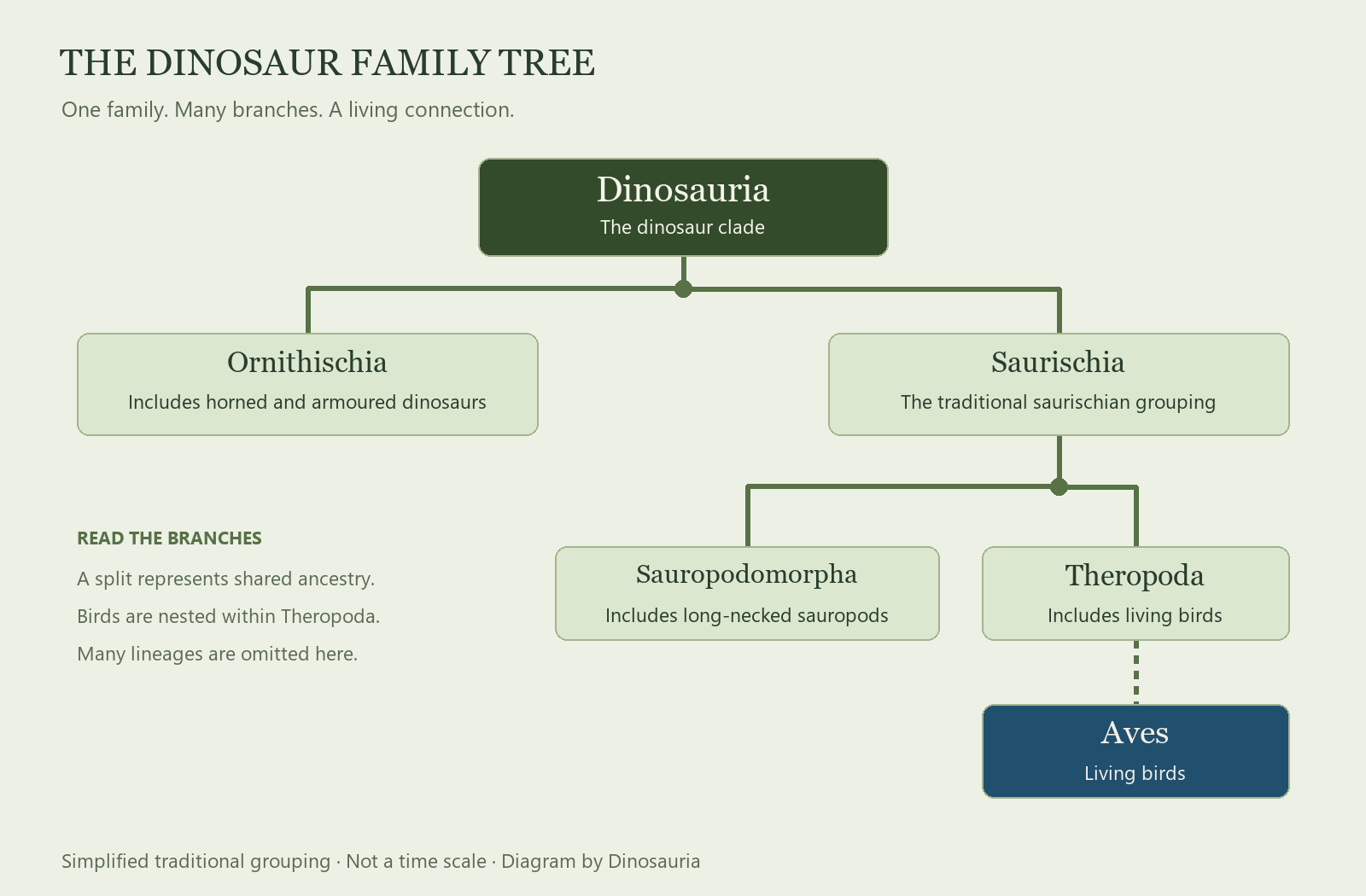
In this context, a clade includes a common ancestor and all its descendants. Clades can nest inside other clades: birds belong within Theropoda, and Theropoda belongs within Dinosauria. Evolution does not remove a lineage from its ancestral groups. [6]
How to read the branches
Start with two groups and trace their branches towards the root until they meet. That meeting point represents their most recent shared ancestor in the model. Groups that share a more recent common ancestor are more closely related. The order of names across the page is less useful than the connections between them. [2]
A branch can be rotated around a branching point without changing the relationships. Nor does a simple cladogram automatically show how long a lineage existed or how much it changed: those meanings require an explicit scale. Fossils and living species may both appear as tips, so a tip is not automatically an animal alive today. [6]
The major dinosaur branches
The traditional arrangement divides Dinosauria into Ornithischia and Saurischia. Ornithischia includes familiar horned and armoured dinosaurs. Traditional Saurischia groups Sauropodomorpha, including the long-necked sauropods, with Theropoda, which includes many familiar predatory dinosaurs and birds. This is a useful introduction, rather than a complete account of every early lineage. [3][4]
The names Ornithischia and Saurischia refer to “bird-hipped” and “lizard-hipped” anatomy. Despite those names, birds belong to the theropod branch. A name based on one anatomical feature is not a substitute for tracing ancestry. [3][4]
Why birds stay in the dinosaur family
Birds evolved within theropod dinosaurs. They are therefore living members of Dinosauria, not a group outside it. This is why an evolutionary tree includes birds alongside extinct dinosaur lineages, and why “non-avian dinosaurs” is useful when discussing dinosaurs other than birds. [4]
Why the tree can change
Researchers compare anatomical characters and test alternative arrangements. New fossils, revised observations and different analyses can alter the result. A tree is a hypothesis supported to varying degrees by evidence, rather than an unchangeable list. [6]
For example, a 2017 study proposed grouping Theropoda with Ornithischia under Ornithoscelida. A subsequent reanalysis found substantial uncertainty around these deep relationships. The proposal should not be read as a universally accepted replacement for the traditional arrangement. [3][5]
Explore with a question in mind
The Dinosauria app follows the branching structure of the Total Dino source spreadsheet; it is an exploratory interpretation, not a final scientific consensus. Try choosing two familiar dinosaurs, tracing their branches back to a shared group, and then comparing that route with the bird lineage. Ask what connects the animals, rather than which one looks more “advanced”.
Continue exploring
- What Is a Dinosaur?
- Saurischia vs Ornithischia
- Did Birds Evolve from Dinosaurs?
- The Rise of Tyrannosaurs
- When Did Dinosaurs Live? The Triassic, Jurassic and Cretaceous Explained
- Dinosauria Glossary
- How Did Dinosaurs Get So Big?
- Velociraptor and Its Relatives: Beyond Jurassic Park
- How Do We Know What Dinosaurs Looked Like?
- Why Did Dinosaurs Go Extinct?
Sources & further reading
- American Museum of Natural History · Tree of Life
- UC Museum of Paleontology · Understanding phylogenies
- Natural History Museum · Dinosaur family tree radically rearranged
- American Museum of Natural History · Why Isn’t Pterodactyl a Dinosaur?
- Langer and colleagues · Nature (2017) · Untangling the dinosaur family tree
- Deborah A. McLennan · Evolution: Education and Outreach · How to Read a Phylogenetic Tree