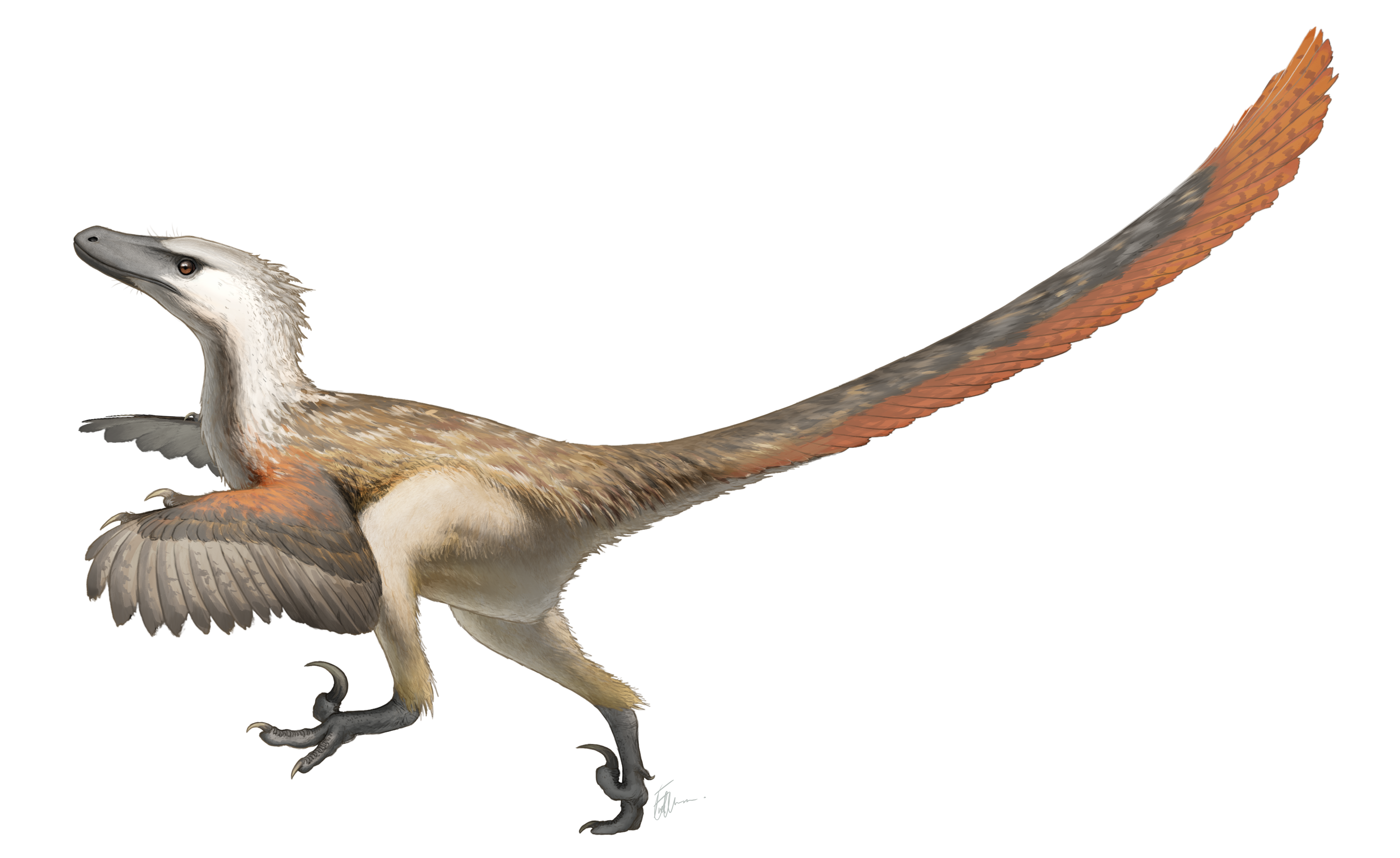
The movie raptor is instantly recognizable: tall, scaly and frighteningly coordinated. The real Velociraptor offers a different picture. It was a relatively small, feathered theropod with a long tail and an enlarged claw on the second toe of each foot. Its relatives broaden the story far beyond one familiar predator. [1][2]
How big was the real Velociraptor?
Velociraptor was roughly two metres long, much of that length belonging to its tail. Its body was much smaller than the human-sized movie animal. It lived during the Late Cretaceous in what is now Asia; despite the film title, it was not a Jurassic dinosaur. [1]
Length alone can create a misleading impression. A long-tailed animal measuring about two metres from nose to tail is not two metres tall. The real proportions become clearer when the head, trunk, hips and tail are considered separately. For the wider time scale, see When Did Dinosaurs Live?.
The evidence for feathers
A Velociraptor forearm described in 2007 preserves quill knobs: small attachment structures associated with large feathers in living birds. This is direct skeletal evidence of substantial arm feathers. It supports a feathered reconstruction without requiring a complete feather impression from that particular animal. [2]
Feathers do not automatically mean powered flight. Velociraptor was flightless, and proposed functions for its plumage include insulation, display and covering eggs. Those functions need to be evaluated separately from the evidence that the feathers existed. The absence of quill knobs in another fossil would not, by itself, prove a bare arm. [1][2]
A family of very different raptors
Velociraptor belongs to Dromaeosauridae, a group of theropods close to birds. Deinonychus was a larger North American relative, important in changing scientific views of predatory dinosaur anatomy. Utahraptor was larger still. Together they show why the small size of Velociraptor does not mean that every dromaeosaurid was small. [1]
Microraptor provides a different contrast. Exceptionally preserved fossils show long feathers on both the forelimbs and hindlimbs, producing the famous four-winged appearance. These structures contributed to research on aerial locomotion, although reconstructing exactly how the animal moved through the air requires further analysis. It was a relative on another branch, not a younger version of Velociraptor. [3]
What was the sickle claw for?
The enlarged second-toe claw is often imagined as a slashing weapon. Functional studies have explored other possibilities. One influential model proposes that dromaeosaurids used their feet to grip prey and their body weight to help restrain it, drawing comparisons with living birds of prey. [4]
That model is based on anatomy and biomechanics; it is not footage of an ancient hunt. A claw can constrain plausible behavior without revealing a single universal hunting routine. Differences in body size and foot anatomy also caution against assigning precisely the same prey-handling strategy to every member of the group. [4]
Did they hunt in packs?
Fossils sometimes preserve several predatory dinosaurs together, or predators associated with a larger herbivore. Such associations can be consistent with social feeding, but they do not establish the coordinated roles of a wolf pack. Animals can gather at food, die in the same trap or accumulate at a site at different times. [5]
Stable-isotope research on Deinonychus teeth has examined dietary differences between younger and older animals. These results have been used to question a simple mammal-like pack model. They do not establish that every dromaeosaurid was always solitary. Social behavior remains a question that needs more than a dramatic scene built around scattered bones. [5]
Close to birds, with their own history
Dromaeosaurids help show how familiar bird features appeared among non-avian dinosaurs. Feathers and specialized limbs were part of a wider evolutionary setting in which different lineages combined them in different ways. Velociraptor was not a bird waiting to become modern; it was an animal adapted to its own world. [2][3]
Follow Did Birds Evolve from Dinosaurs? for the broader relationship, or How Do We Know What Dinosaurs Looked Like? for the reconstruction process. The tree links below open named taxa so you can compare their positions for yourself.
When exploring, compare named branches rather than treating the displayed order as a ladder of progress. A small animal is not necessarily primitive, and a large one is not necessarily a later improvement. Shared ancestry explains the grouping; size, plumage and movement describe different aspects of the animals themselves. The Dinosauria Glossary explains the distinction between a genus, a species and a clade.
Explore these taxa in the tree
Continue exploring
- What Is a Dinosaur?
- The Dinosaur Family Tree: Understanding Dinosaur Evolution
- Saurischia vs Ornithischia
- Did Birds Evolve from Dinosaurs?
- The Rise of Tyrannosaurs
- When Did Dinosaurs Live? The Triassic, Jurassic and Cretaceous Explained
- Dinosauria Glossary
- How Did Dinosaurs Get So Big?
- How Do We Know What Dinosaurs Looked Like?
- Why Did Dinosaurs Go Extinct?
Sources & further reading
- Vicious Velociraptor: tales of a turkey-sized dinosaur. (Natural History Museum)
- Turner, Makovicky and Norell (2007). Feather quill knobs in the dinosaur Velociraptor. (Science)
- Xu et al. (2003). Four-winged dinosaurs from China. (Nature)
- Fowler et al. (2011). The predatory ecology of Deinonychus and the origin of flapping in birds. (PLOS ONE)
- Frederickson et al. (2020). Ontogenetic dietary shifts in Deinonychus antirrhopus. (Palaeogeography, Palaeoclimatology, Palaeoecology)