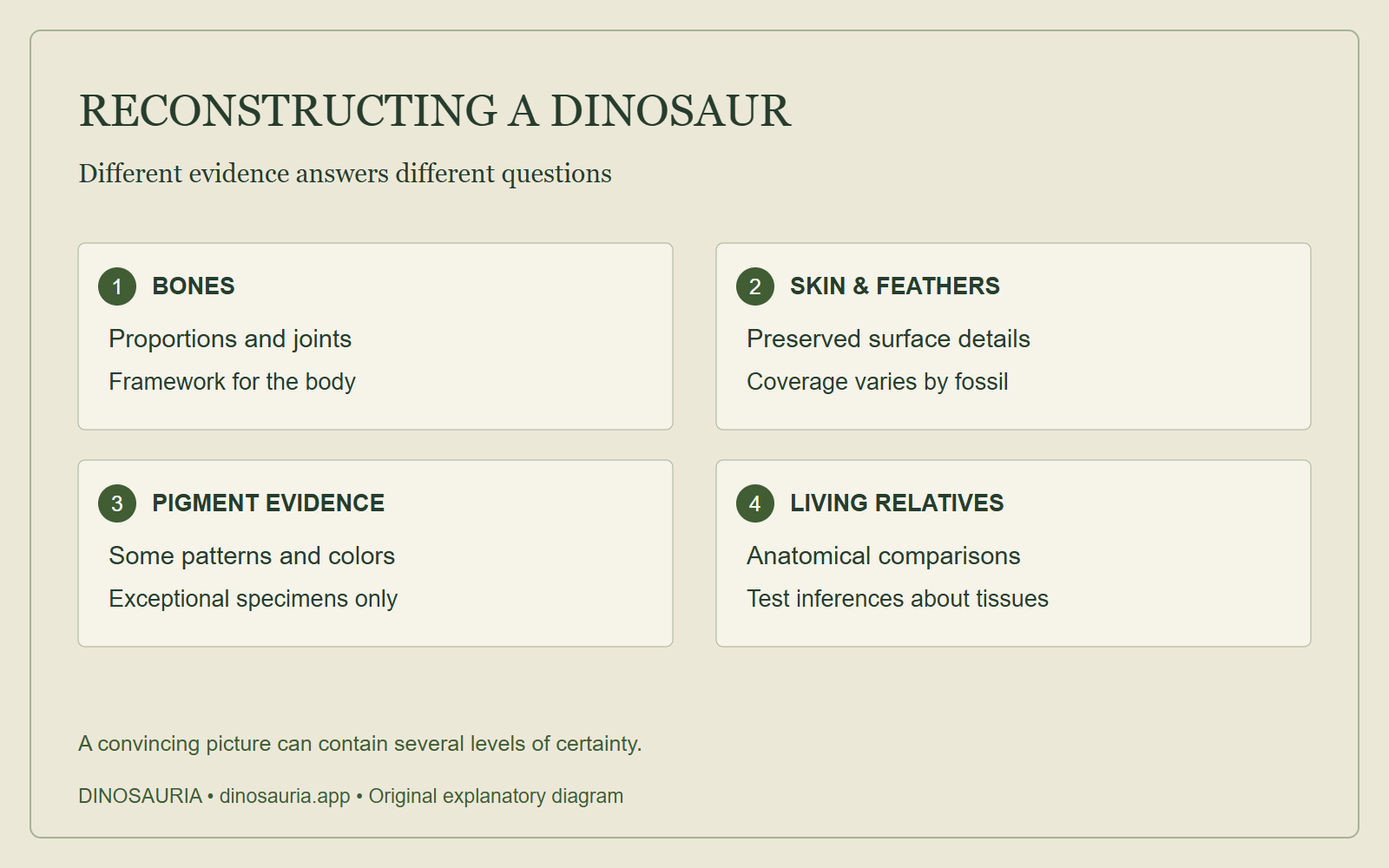
A dinosaur painting can feel like a window into the past. In reality, it is a reconstruction built from several kinds of evidence, joined by anatomical reasoning and artistic decisions. Some features are directly preserved. Others are inferred from relatives or remain uncertain. Reading the image means learning to recognize those different levels of support.
Start with the bones
A skeleton provides the framework: proportions, joint surfaces, attachment sites and the arrangement of the teeth. It restricts the possible shapes of the animal, even when much of the soft tissue is missing. Yet the outline of a skeleton is not the outline of a living body. Muscles, skin and other tissues change the silhouette. [1]
Completeness matters. A reconstruction based on several well-preserved skeletons has a different foundation from one based on a few bones. Missing regions are often restored using close relatives. Museum mounts and illustrations should therefore be read as evidence-based interpretations rather than literal copies of a single complete fossil.
Compare living relatives carefully
Birds and crocodilians provide essential comparisons for reconstructing extinct dinosaurs. Features shared across those living branches can help researchers infer the likely anatomy of their extinct relatives. This comparative method works best when the relationship and the anatomical feature are specified; resemblance alone is a weaker guide. [1]
Living birds are especially valuable because they are dinosaurs themselves. But no modern bird is a universal substitute for every extinct species. A hummingbird, an ostrich and a crocodile solve different anatomical problems. Read Did Birds Evolve from Dinosaurs? for the ancestry that makes these comparisons useful.
Skin impressions and feathers add the surface
Exceptional fossils preserve traces that bones cannot supply: scale patterns, outlines of soft tissues and feather impressions. Such evidence can change an animal’s appearance dramatically. Microraptor fossils, for example, preserve long feathers associated with both pairs of limbs. Those discoveries require a different reconstruction from a bare, scaly outline. [2]
Sometimes the evidence is indirect but strong. Quill knobs on a Velociraptor forearm mark attachment sites for feathers. They provide support for feathered arms even without a halo of plumage preserved around that bone. For the species and its relatives, see Velociraptor: Beyond Jurassic Park. [3]
A patch of fossil skin is a local sample, not a complete body covering. Reconstructing the rest requires attention to which part of the animal is preserved, its age, and what comparable specimens show. Scales in one region do not automatically establish that every region lacked feathers.
Can scientists really recover dinosaur colors?
In some exceptional fossils, researchers identify microscopic structures interpreted as melanosomes, the organelles that contain melanin pigments. Their shape and distribution can be compared with those in living animals. Work on Sinosauropteryx supported a banded tail with reddish-brown coloration in the darker regions. That is evidence for particular parts of particular fossils, not a color chart for all dinosaurs. [4]
Color reconstruction has limits. Preservation can alter structures and chemistry, and not every color-producing mechanism leaves the same fossil signal. Methods are strongest when microscopic observations, chemical evidence and comparative data agree. Many animals still lack recoverable color evidence, leaving artists with a range of plausible choices. [5]
Anatomy is easier to recover than a complete performance
An image also chooses a pose, a facial expression, a setting and a moment of behavior. Those choices can communicate a scientific hypothesis, but they often go beyond what one fossil establishes. A skeleton cannot independently reveal a mating display or a coordinated hunting maneuver.
The same caution applies to sounds. The presence of feathers is an anatomical claim that can be tested against fossils. A particular call or emotional expression is a different kind of reconstruction, with different evidence requirements. A realistic style of illustration does not make every detail equally certain.
Why dinosaur art changes
Reconstructions change when new specimens, improved comparisons or new analytical methods alter the evidence. Adding feathers to a familiar theropod is not simply a fashion choice when fossil discoveries support that change. Conversely, a visually striking new interpretation should still explain which evidence supports it. [2][3]
This makes good palaeoart a useful companion to research. The most informative images allow readers to distinguish preserved anatomy, reasonable inference and open choices. For body-size reconstruction, explore How Did Dinosaurs Get So Big?. For definitions of fossil, inference and related terms, use the Dinosauria Glossary.
Look at the evidence behind the image
When you next see a reconstruction, ask what is actually preserved, which relatives informed it, and which details remain choices. That approach makes the illustration more interesting: you are seeing both an animal and a testable explanation of its appearance. Use the taxa below to explore examples from different branches of the family.
Explore these taxa in the tree
Continue exploring
- What Is a Dinosaur?
- The Dinosaur Family Tree: Understanding Dinosaur Evolution
- Saurischia vs Ornithischia
- Did Birds Evolve from Dinosaurs?
- The Rise of Tyrannosaurs
- When Did Dinosaurs Live? The Triassic, Jurassic and Cretaceous Explained
- Dinosauria Glossary
- How Did Dinosaurs Get So Big?
- Velociraptor and Its Relatives: Beyond Jurassic Park
- Why Did Dinosaurs Go Extinct?
Sources & further reading
- Witmer (1995). The extant phylogenetic bracket and the importance of reconstructing soft tissues in fossils. (Cambridge University Press)
- Xu et al. (2003). Four-winged dinosaurs from China. (Nature)
- Turner, Makovicky and Norell (2007). Feather quill knobs in the dinosaur Velociraptor. (Science)
- Zhang et al. (2010). Fossilized melanosomes and the colour of Cretaceous dinosaurs and birds. (Nature)
- Recent advances in amniote palaeocolour reconstruction and a framework for future research. (Biological Reviews)