Picture a Stegosaurus beside a Tyrannosaurus rex. It feels like a familiar prehistoric scene, yet those animals lived tens of millions of years apart. The age of dinosaurs was an immense stretch of changing landscapes and communities, rather than one world filled with every famous species. [10][11]
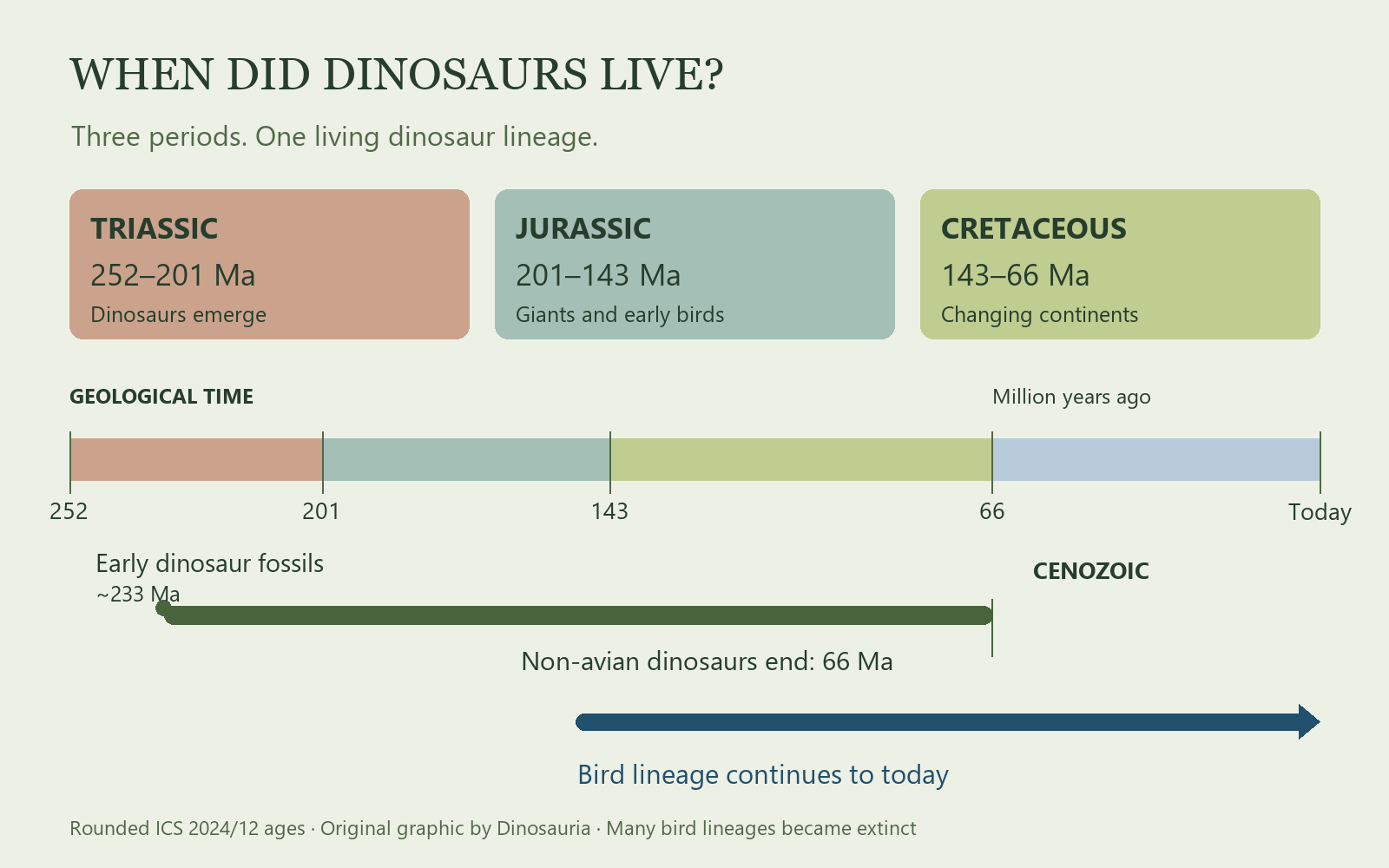
Dinosaurs appeared during the Triassic Period. They diversified through the Jurassic and Cretaceous, and all non-avian dinosaurs became extinct about 66 million years ago. Birds survived. So the answer to “when did dinosaurs live?” has two parts: their Mesozoic history, and the living branch that is still here. [2][3]
Three periods within one era
The Mesozoic Era contains three consecutive periods: the Triassic, about 252–201 million years ago; the Jurassic, about 201–143 million years ago; and the Cretaceous, about 143–66 million years ago. Together they span roughly 186 million years. Dinosaurs were present for only part of the Triassic, so this is longer than the interval between their earliest well-supported fossils and the extinction of non-avian dinosaurs. [2][4]
These dates are rounded from the December 2024 International Chronostratigraphic Chart. Older books and some museum pages place the Jurassic–Cretaceous boundary at about 145 million years ago; the chart used here estimates 143.1 million years. Numerical estimates can be revised as evidence improves. Periods are divisions of geological time, not separate types of dinosaur. [4]
The Triassic: dinosaurs enter the story
The Triassic began after the devastating end-Permian mass extinction, long before the first well-supported dinosaur fossils. Much of Earth’s land was joined in the supercontinent Pangaea. Its vast interior included hot, seasonally dry environments, although conditions varied across the planet. The world in which dinosaurs emerged already contained many other successful animal lineages. [5]
Well-supported early dinosaur fossils occur around 233 million years ago, in the Late Triassic. Older candidates exist, but fragmentary remains and uncertain relationships make an exact starting date difficult to establish. A first fossil appearance is the oldest evidence recovered so far, rather than a record of the very first individual. [2]
Eoraptor and Herrerasaurus help bring this early chapter into focus. Dinosaurs initially shared ecosystems with a variety of other reptiles; they did not immediately dominate every landscape. For the question of which animals belong inside the group, begin with What Is a Dinosaur?. The Triassic supplies the opening setting, while ancestry determines membership. [5]
The Jurassic: giants, predators and early birds
An extinction at the end of the Triassic reshaped ecosystems. Dinosaurs survived that disruption and became prominent in many Jurassic land communities. Pangaea continued to break apart, while changing seas, climates and vegetation created new settings for evolution. A Jurassic forest was not simply a modern forest with giant reptiles added. [5][6]
The Jurassic includes some of the most recognizable dinosaur assemblages. Late Jurassic rocks in western North America preserve long-necked sauropods such as Diplodocus, the plated Stegosaurus and predators such as Allosaurus. Those examples describe particular places and intervals; the period lasted nearly 60 million years, with substantial change from beginning to end. [6]
This was also a chapter in avian history. Archaeopteryx lived in the Late Jurassic, around 150 million years ago, combining feathers with teeth, clawed fingers and a long bony tail. Early birds therefore overlapped with non-avian dinosaurs long before the end-Cretaceous extinction. The familiar contrast between birds and dinosaurs conceals a much older family connection. [3][6]
The Cretaceous: a long world of change
The Cretaceous was the longest of the three Mesozoic periods, lasting roughly 77 million years on the time scale used here. Continents continued to separate, and high sea levels flooded extensive areas. Regional dinosaur communities developed against that shifting geography. Flowering plants diversified and became increasingly important, changing the vegetation available to animals. [4][7]
Tyrannosaurus and Triceratops belong near the very end of this long period, rather than throughout it. Other Cretaceous dinosaurs lived millions of years earlier and often on different continents. “Cretaceous” provides a useful broad address in time, but it cannot by itself establish that two animals met. Local rock formations and more precise ages are needed to test that possibility. [1][7]
The rise of tyrannosaurs follows one lineage through this wider history. Another view comes from Saurischia vs Ornithischia, which compares major branches of the family. A period name tells us when; a clade name tells us about relationships. Both are needed to understand a dinosaur’s place in the story.
Could Stegosaurus have met T. rex?
No. Stegosaurus is a Late Jurassic dinosaur, while Tyrannosaurus rex lived near the end of the Cretaceous. Using roughly 150 million years ago for a Stegosaurus and roughly 67 million years ago for T. rex gives a gap of about 83 million years. That is greater than the approximately 67 million years separating that T. rex from us. These are illustrative dates, not precise lifespans for entire genera. [10][11]
This comparison changes how a prehistoric scene should be read. Sharing the label “dinosaur” is no more a guarantee of meeting than sharing a branch of a family tree. Time and geography constrain the possible neighbours of every fossil animal.
What happened 66 million years ago?
The Cretaceous ended with a mass extinction at the Cretaceous–Paleogene boundary, often abbreviated K–Pg. The Chicxulub asteroid impact, centred on what is now Mexico’s Yucatán region, triggered catastrophic environmental disruption. Reduced sunlight and rapid climatic changes undermined photosynthesis and the food webs that depended on it. The crisis affected both land and sea. [8]
All non-avian dinosaurs disappeared, along with many other organisms. The boundary also marks the end of the Mesozoic and the beginning of the Cenozoic Era. It does not mark the moment when dinosaurs turned into birds: birds had already evolved and had lived alongside their non-avian relatives for tens of millions of years. [3][8]
Why the dinosaur timeline reaches the present
Birds are theropod dinosaurs. Their surviving lineages carried dinosaur ancestry across the K–Pg boundary, eventually producing the living diversity that includes penguins, ostriches, pigeons and hummingbirds. Many ancient bird lineages died out as well. Saying “birds survived” describes the persistence of a subset, not universal protection from the disaster. [3][9]
Why particular birds survived remains a research question. One study links the extinction’s destruction of forests to a survival advantage for ancestors that did not depend on living in trees. That is an evidence-based hypothesis about ecology, not a rule that flight or feathers guaranteed survival. The pattern needs to be interpreted against an incomplete fossil record. [9]
Our article Did Birds Evolve from Dinosaurs? follows the anatomical evidence behind this living connection. A bird outside your window belongs within Dinosauria today. The Mesozoic ended; that family history continued.
Put time beside the family tree
Use the dinosaur family tree to follow relationships, then put the animals into their geological settings. The tree’s branch lengths do not represent elapsed time. An early branch is not automatically a Triassic animal, and a later fossil is not automatically the direct descendant of an earlier one.
The links below open each taxon in the interactive tree. Compare an early dinosaur, a Jurassic example, a late Cretaceous predator and the living bird branch. They are four entry points into one family’s history, spread across a remarkable depth of time.
Explore these taxa in the tree
Continue exploring
- What Is a Dinosaur?
- The Dinosaur Family Tree: Understanding Dinosaur Evolution
- Saurischia vs Ornithischia
- Did Birds Evolve from Dinosaurs?
- The Rise of Tyrannosaurs
- Dinosauria Glossary
- How Did Dinosaurs Get So Big?
- Velociraptor and Its Relatives: Beyond Jurassic Park
- How Do We Know What Dinosaurs Looked Like?
- Why Did Dinosaurs Go Extinct?
Sources & further reading
- When did dinosaurs live? (Natural History Museum)
- Bernardi et al. (2018). Dinosaur diversification linked with the Carnian Pluvial Episode. (Nature Communications)
- Brusatte, O’Connor and Jarvis (2015). The Origin and Diversification of Birds. (Current Biology)
- International Chronostratigraphic Chart, version 2024/12. Numerical ages carry uncertainties; this article uses rounded estimates. (International Commission on Stratigraphy)
- The Triassic Period: the rise of the dinosaurs. (Natural History Museum)
- The Jurassic Period: How did dinosaurs go from basal to bulky? (Natural History Museum)
- The Cretaceous Period: What was Earth like before dinosaurs went extinct? (Natural History Museum)
- Mass Extinctions Through Geologic Time. (National Park Service)
- Field et al. (2018). Early Evolution of Modern Birds Structured by Global Forest Collapse at the End-Cretaceous Mass Extinction. (Current Biology · author repository)
- Dino Directory: Stegosaurus. (Natural History Museum)
- Dino Directory: Tyrannosaurus. (Natural History Museum)