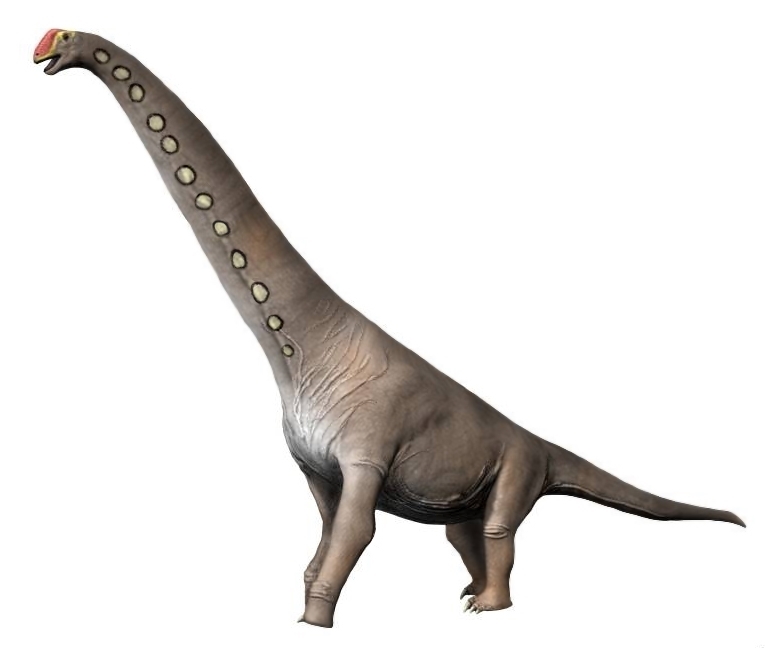
A long neck rises above a body supported by four massive legs. For many people, this is the defining image of a giant dinosaur. Sauropods carried land-animal size to extraordinary extremes, but their success was more complicated than simply growing a larger skeleton. Their bodies combined feeding, breathing and reproductive adaptations that researchers study as an interacting system. [1][2]
Not every dinosaur was a giant
Dinosauria includes animals spanning an enormous range of sizes, including living birds. Sauropods were one particularly successful experiment in large bodies. They belonged within Sauropodomorpha, a branch that also includes earlier animals with different proportions and ways of moving. The largest forms were the outcome of a long evolutionary history, rather than the original dinosaur design. [2]
Start with the dinosaur family tree to place sauropods alongside theropods and ornithischians. The word giant describes a size; sauropod identifies a branch with shared ancestry.
A long neck made feeding more economical
A long neck allowed an animal to reach vegetation across a broad feeding area while moving its heavy trunk relatively little. This could reduce the cost of collecting large quantities of food. Height was useful, but reaching high into trees was only one possibility: different sauropods had different neck proportions and likely used different feeding envelopes. [1][2]
Sauropods combined long necks with comparatively small heads. They did not process vegetation with the elaborate chewing systems seen in some other large herbivores. Swallowing food with limited oral processing helped keep the head light, making an exceptionally long neck more feasible. This was a different feeding solution from carrying a large head full of grinding teeth. [1]
Air sacs and a lighter supporting structure
Sauropod vertebrae often contain extensive internal air spaces. These provide evidence of respiratory air sacs and their extensions into the skeleton, comparable in important respects to structures in birds. Replacing some bone with air spaces reduced the mass of the neck and trunk without turning the skeleton into a fragile empty shell. [2]
Air sacs and lungs have different jobs. In living birds, sacs help ventilate the lungs, where gas exchange occurs. Fossil bones can reveal the presence of air-filled structures, while the detailed physiology of an extinct animal must be reconstructed indirectly. A bird-like respiratory arrangement is part of the proposed explanation for sauropod size, not a complete breathing system preserved in stone. [2]
Growing large, one generation at a time
Large animals require enormous amounts of food and time to build their bodies. Researchers therefore examine growth, metabolism and reproduction alongside adult anatomy. Egg laying meant that a gigantic adult could begin life as a comparatively tiny hatchling; producing offspring did not require carrying an adult-sized baby. [1]
The evolutionary cascade model connects inherited features and later innovations: small heads helped permit long necks; efficient food gathering supported large bodies; other aspects of breathing and growth helped make that arrangement workable. It is a model of interacting advantages, with individual links available for testing. It does not propose that evolution was working toward a predetermined maximum size. [1]
Diplodocus, Brachiosaurus and Patagotitan
Diplodocus and Brachiosaurus represent contrasting long-necked body plans. Diplodocus had a particularly elongated body and tail, whereas Brachiosaurus had relatively long forelimbs that raised its shoulders. Both are associated with the Late Jurassic, but they should not be treated as interchangeable animals. [2]
Patagotitan was a Cretaceous titanosaur from what is now Argentina. Its fossils include multiple individuals and some truly immense limb bones. The museum mount helps communicate the scale of the animal, but a mounted skeleton is a reconstruction assembled from evidence, rather than a single perfectly complete individual. [3]
Why the biggest dinosaur is hard to name
Longest, tallest and heaviest are different records. A long, slender tail can add length without adding the mass of a deeper trunk. Incomplete fossils also force researchers to estimate missing parts using relatives, and different reconstruction methods can produce different results. [2][3]
A responsible comparison therefore names the measurement and acknowledges uncertainty. Patagotitan belongs among the remarkable giants; presenting one exact weight as a settled verdict for every contender would hide how those estimates are made. The uncertainty is part of the scientific story.
Explore the giants in Dinosauria
Use the links below to compare three entry points into sauropod diversity. Their positions show relationships, not a ranking by size. For geological context, read When Did Dinosaurs Live?; for the evidence behind restored bodies, continue with How Do We Know What Dinosaurs Looked Like?.
Explore these taxa in the tree
Continue exploring
- What Is a Dinosaur?
- The Dinosaur Family Tree: Understanding Dinosaur Evolution
- Saurischia vs Ornithischia
- Did Birds Evolve from Dinosaurs?
- The Rise of Tyrannosaurs
- When Did Dinosaurs Live? The Triassic, Jurassic and Cretaceous Explained
- Dinosauria Glossary
- Velociraptor and Its Relatives: Beyond Jurassic Park
- How Do We Know What Dinosaurs Looked Like?
- Why Did Dinosaurs Go Extinct?
Sources & further reading
- Sander (2013). An evolutionary cascade model for sauropod dinosaur gigantism: overview, update and tests. (PLOS ONE)
- Sander et al. (2011). Biology of the sauropod dinosaurs: the evolution of gigantism. (Biological Reviews)
- Meet Patagotitan mayorum! The Museum’s largest dinosaur. (American Museum of Natural History)