Tyrannosaurus rex makes tyrannosaur evolution look like a story of inevitable gigantism. Its huge head and powerful jaws dominate the popular image of the group. Yet the wider tyrannosaur lineage stretches back well before T. rex and includes animals with very different proportions. For much of that history, many tyrannosauroids were relatively small predators living alongside larger carnivores. The giants arrived late in a branching story. [1]
A species within a wider radiation
Tyrannosaurus rex is one species. Tyrannosaurus is its genus. Tyrannosauridae is the family containing it and close relatives such as Tarbosaurus, while Tyrannosauroidea is the broader group containing tyrannosaurids and earlier-diverging relatives. Keeping those levels separate helps prevent every reference to a tyrannosaur from becoming a claim about T. rex itself. The broader group contained forms that were not miniature copies of the famous animal. [1]
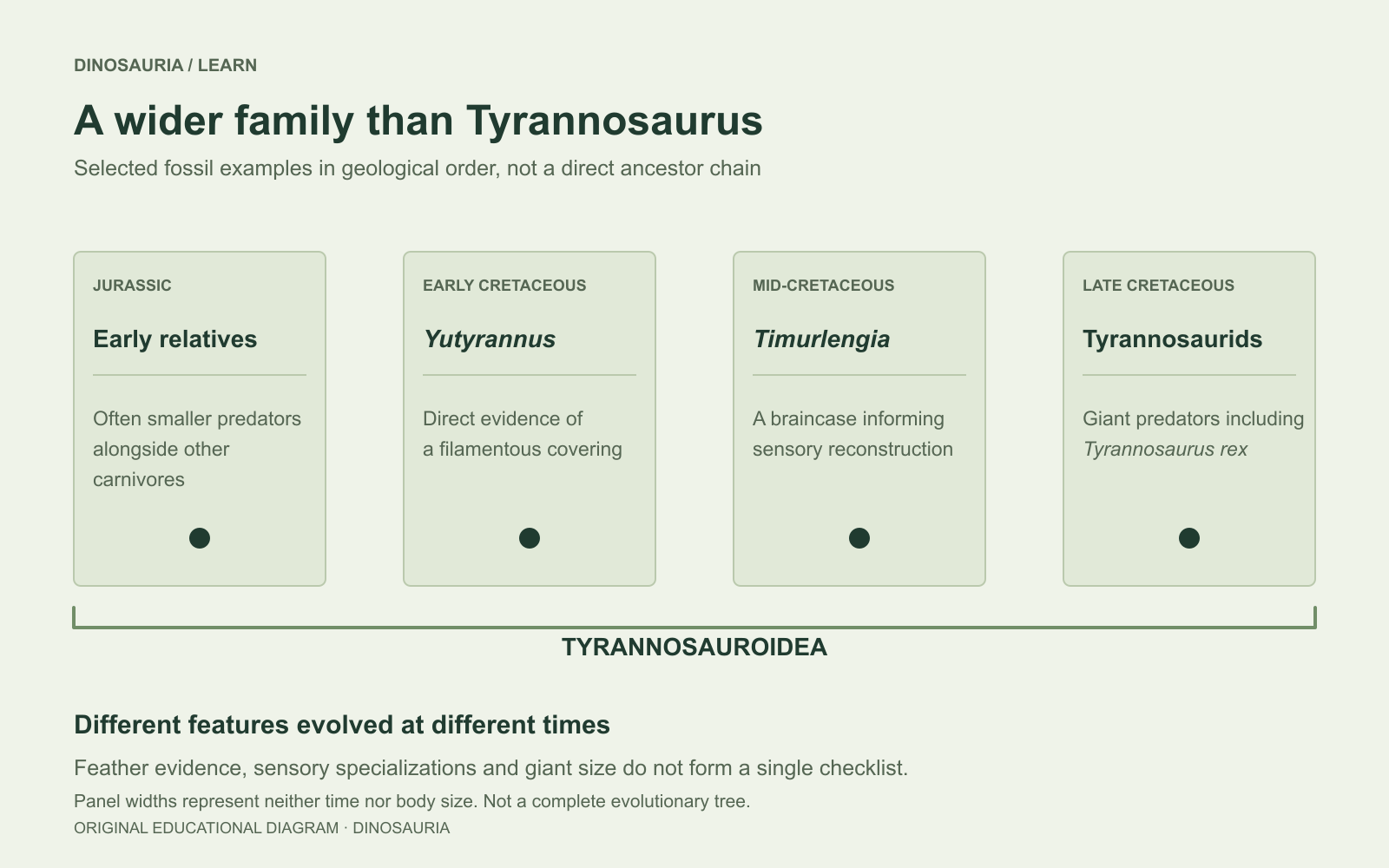
The difference matters on an evolutionary tree. An earlier tyrannosauroid may preserve clues about the history of the group while belonging to its own side branch. It need not be a direct ancestor of Tyrannosaurus. A dated series of illustrations can therefore show representative relatives without implying that each species turned into the next. The diagram should branch wherever relationships require it.
The early relatives were varied
The fossil record places tyrannosauroids in the Jurassic, long before the last chapters of the Cretaceous. Early members often had smaller bodies and longer arms relative to their size than the later giant tyrannosaurids. They occupied a world with other major predatory dinosaur lineages. Their presence did not mean they immediately dominated the top of every food web. [1]
The fossil gaps are important. Tyrannosauroids are sampled unevenly across time and geography, and fragmentary finds can leave relationships unresolved. A group may have existed in an area without leaving a fossil we have discovered. Reconstructing its spread therefore requires distinguishing known occurrences from inferred movements. A map of collecting sites is evidence for a history, rather than a complete record of it.
Feathers in the broader family
Yutyrannus, an Early Cretaceous tyrannosauroid from China, was described from three nearly complete skeletons with evidence of a filamentous covering. It demonstrates that a large-bodied member of the wider group could carry feathers. Feathered tyrannosauroids challenge the old assumption that a substantial dinosaur predator must have had an entirely scaly exterior. [2]
Yutyrannus does not settle the appearance of every relative. Skin impressions attributed to Tyrannosaurus and other tyrannosaurids preserve scales on sampled body regions. These observations establish scaly skin where it is preserved; they do not provide a complete map of every individual's body covering. The reconstruction of an adult T. rex should distinguish direct evidence from extrapolation, with colour and many soft tissues remaining uncertain. [3]
Sensory changes before the largest bodies
Timurlengia, known from the mid-Cretaceous of Uzbekistan, provides evidence about a stage poorly represented in the fossil record. Study of its braincase and inner ear suggested sensory specializations despite a body far smaller than the later giants. The finding supports the idea that some important features of tyrannosaur sensory biology developed before the evolution of enormous tyrannosaurid bodies. [4]
That sequence is more informative than saying tyrannosaurs became big and therefore became successful. Different parts of the animal changed at different times. Braincase anatomy, limb proportions, skull construction and body size need not evolve together. Nor does evidence for a sensory specialization tell us exactly how an animal hunted. Behaviour has to be inferred cautiously from several kinds of evidence.
The emergence of giant tyrannosaurids
By the Late Cretaceous, tyrannosaurids included very large predators in Asia and North America. Their deep skulls, substantial teeth and strongly built jaws form a distinctive feeding apparatus. The evolutionary radiation was not uniform: different species lived in different places and at different times. Tyrannosaurus belonged to the final part of this history in western North America, near the end of the Cretaceous. [1]
Biomechanical studies suggest that adult T. rex could generate powerful bites capable of damaging and fragmenting bone. Such estimates combine fossil anatomy with assumptions about muscles and mechanics. They explain functional possibilities rather than directly measuring a living animal. A fossil jaw can strongly constrain a model while still allowing uncertainty in its numerical output. For that reason, a single dramatic bite-force number can be less useful than understanding how the estimates are obtained. [5]
New fossils can change familiar stories
Even the latest tyrannosaur ecosystems are still being reinterpreted. A 2025 study presented evidence that Nanotyrannus and Tyrannosaurus coexisted near the end of the Cretaceous. This matters because some small tyrannosaur fossils had previously been interpreted as immature T. rex. Distinguishing a young individual from a small-bodied relative affects reconstructions of growth, diversity and ecology. [6]
A new interpretation should be considered with its underlying anatomy and growth evidence, rather than treated as a slogan that resolves every specimen. Specific identifications and placements on the tree still need scrutiny. The broad lesson is that tyrannosaur evolution cannot be reduced to one large species with all smaller forms automatically assigned to its juvenile stages.
A successful radiation with an abrupt end
Tyrannosauroids offer a good example of how evolution assembles a recognizable body plan over time. Their history includes smaller predators, feathered forms, sensory changes and giant tyrannosaurids. Those features appeared across a branching family, not as a predetermined checklist leading toward T. rex. An earlier animal was a complete organism adapted to its own setting, rather than an unfinished version of a later giant.
The end-Cretaceous mass extinction about 66 million years ago eliminated tyrannosaurs along with all other non-avian dinosaurs. Birds survived, but they descended from another theropod branch; they are not living descendants of T. rex. Following tyrannosaurs through a cladogram places the familiar predator in a wider history, while showing how much of that history still depends on the next fossil and the next careful comparison. [7]
Continue exploring
- What Is a Dinosaur?
- The Dinosaur Family Tree: Understanding Dinosaur Evolution
- Saurischia vs Ornithischia
- Did Birds Evolve from Dinosaurs?
- When Did Dinosaurs Live? The Triassic, Jurassic and Cretaceous Explained
- Dinosauria Glossary
- How Did Dinosaurs Get So Big?
- Velociraptor and Its Relatives: Beyond Jurassic Park
- How Do We Know What Dinosaurs Looked Like?
- Why Did Dinosaurs Go Extinct?
Sources & further reading
- Brusatte and Carr. 2016. The phylogeny and evolutionary history of tyrannosauroid dinosaurs. (Scientific Reports (2016))
- Xu et al. 2012. A gigantic feathered dinosaur from the Lower Cretaceous of China. (Nature (2012))
- Bell et al. 2017. Tyrannosauroid integument reveals conflicting patterns of gigantism and feather evolution. (Biology Letters (2017))
- Brusatte et al. 2016. New tyrannosaur from the mid-Cretaceous of Uzbekistan clarifies evolution of giant body sizes and advanced senses in tyrant dinosaurs. (PNAS (2016))
- Gignac and Erickson. 2017. The Biomechanics Behind Extreme Osteophagy in Tyrannosaurus rex. (Scientific Reports (2017))
- Zanno and Napoli. 2025. Nanotyrannus and Tyrannosaurus coexisted at the close of the Cretaceous. (Nature (2025))
- Natural History Museum. When did dinosaurs live? (Natural History Museum)