
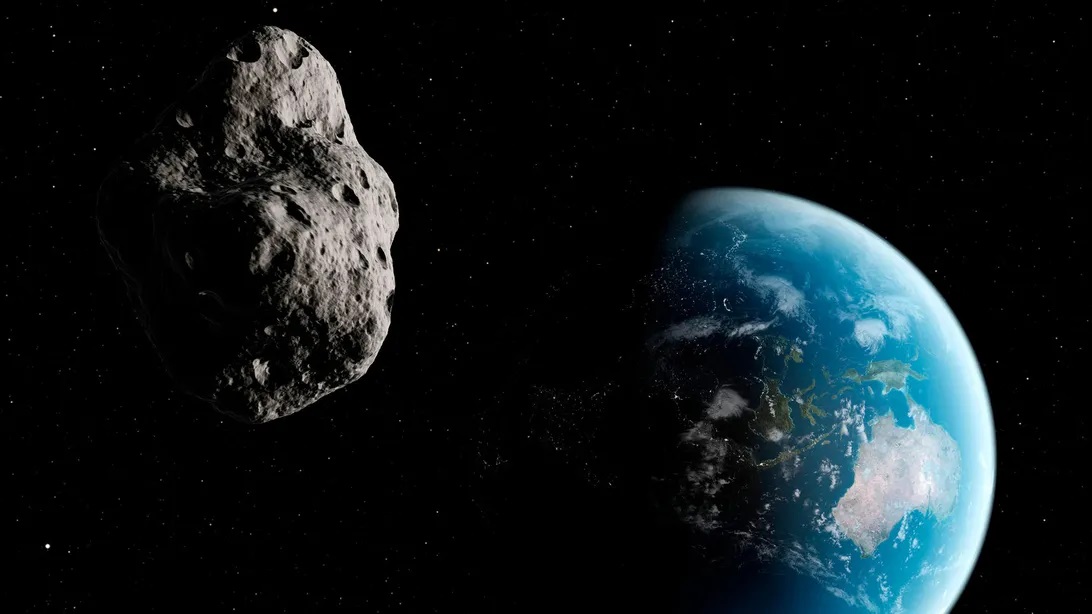
About 66 million years ago, the world crossed a boundary that ended the age of non-avian dinosaurs. The leading explanation is the Chicxulub asteroid impact and its environmental consequences. The crucial distinction is that dinosaurs did not vanish entirely: some bird lineages survived, and their descendants are still alive. [1]
What ended at the K–Pg boundary?
The Cretaceous–Paleogene boundary, abbreviated K–Pg, marks a mass extinction affecting both land and sea. Non-avian dinosaurs disappeared, along with many other groups. It was a planetary ecological crisis, not an event limited to the familiar giants on land. Roughly three-quarters of species are estimated to have become extinct. [1]
Birds had already evolved long before this boundary. They did not suddenly emerge from surviving Tyrannosaurus after the impact. The distinction between avian and non-avian dinosaurs describes branches of the family tree, as explained in Did Birds Evolve from Dinosaurs?.
The evidence points to Chicxulub
The impact structure lies beneath and around the Yucatán Peninsula in Mexico. Its enormous buried crater, together with impact-related material found at the boundary, connects a specific geological event with a global disruption. Scientists reconstruct its formation using drilling, geophysical imaging and the study of affected rocks. [1]
The asteroid’s energy caused devastation near the impact site. But a local catastrophe alone does not explain extinctions across distant continents and oceans. For that, the important question is how material launched into the atmosphere changed conditions far beyond the crater. [1]
How an impact disrupted sunlight and food
Dust, sulfate aerosols and soot could reduce the sunlight reaching the surface and cool the planet. Researchers describe this as an impact winter. Its intensity and duration depend on the properties and quantities of material injected into the atmosphere. The exact contributions of different particles remain active subjects of research. [1][2]
One modeling study emphasized the potential importance of fine silicate dust in sustaining darkness and cooling. This helps explain a mechanism; it does not turn every modeled temperature or duration into a direct measurement of the ancient atmosphere. Fossils, sediments and climate simulations provide different pieces of the reconstruction. [2]
Less light means less photosynthesis. When plants and photosynthetic plankton struggle, food becomes scarce for the organisms that eat them and for predators farther up the food web. A top predator can be threatened even far from the crater because its prey depends on those underlying sources of energy. [1][2]
What about the volcanoes?
The Deccan Traps eruptions in what is now India occurred around the same broad interval. Volcanic gases can affect climate through different mechanisms: carbon dioxide contributes to warming, while sulfur compounds can contribute to cooling. Establishing their role requires resolving timing, emissions and environmental response. [3][4]
Research differs over the magnitude and timing of volcanic stress. One study measured sulfur and fluorine in Deccan lavas to examine potential environmental effects. Another combined climate and habitat modeling and found that impact-driven conditions, rather than volcanism alone, best explained the loss of suitable dinosaur habitat. [3][4]
The responsible conclusion is that Chicxulub is the best-supported principal trigger of the abrupt mass extinction. The degree to which volcanism stressed ecosystems before it, or affected later recovery, remains part of the wider scientific discussion. Recognizing that discussion does not make all proposed explanations equally supported. [1][3][4]
Why did some birds survive?
Many ancient birds also became extinct. Survival was selective, rather than a protection granted to anything with feathers or wings. The lineages that persisted eventually diversified into today’s birds, carrying dinosaur ancestry across the boundary. [5]
One hypothesis links bird survival to the destruction of forests. Research combining plant evidence and evolutionary relationships proposed that ancestors not dependent on trees had an advantage when forest habitats collapsed. It is an explanation to test against an incomplete record, rather than a universal survival formula. Food resources, habitat and other ecological factors must also be considered. [5]
The dinosaur story continues
Saying that non-avian dinosaurs went extinct is more accurate than saying that every dinosaur died. The end of the Cretaceous closed entire branches while a small portion of the bird lineage continued. Living birds belong within Dinosauria today.
Use When Did Dinosaurs Live? to place the event in geological time, then follow the links below to late Cretaceous dinosaurs and the bird branch. The tree shows relationships; it does not indicate that the surviving birds descended from the particular non-avian dinosaurs shown beside them.
Explore these taxa in the tree
Continue exploring
- What Is a Dinosaur?
- The Dinosaur Family Tree: Understanding Dinosaur Evolution
- Saurischia vs Ornithischia
- Did Birds Evolve from Dinosaurs?
- The Rise of Tyrannosaurs
- When Did Dinosaurs Live? The Triassic, Jurassic and Cretaceous Explained
- Dinosauria Glossary
- How Did Dinosaurs Get So Big?
- Velociraptor and Its Relatives: Beyond Jurassic Park
- How Do We Know What Dinosaurs Looked Like?
Sources & further reading
- The Chicxulub impact and its environmental consequences (2022). (Nature Reviews Earth & Environment)
- Senel et al. (2023). Chicxulub impact winter sustained by fine silicate dust. (Nature Geoscience)
- Chiarenza et al. (2020). Asteroid impact, not volcanism, caused the end-Cretaceous dinosaur extinction. (PNAS)
- Recurring volcanic winters during the latest Cretaceous: sulfur and fluorine budgets of Deccan Traps lavas (2023). (Science Advances)
- Field et al. (2018). Early evolution of modern birds structured by global forest collapse at the end-Cretaceous mass extinction. (Current Biology)