Tyrannosaurus and Triceratops make a striking pair: one a large predator, the other a horned plant eater. In the traditional dinosaur family tree, they also represent different major branches. Tyrannosaurus belongs to Saurischia; Triceratops belongs to Ornithischia. The names translate roughly as lizard-hipped and bird-hipped. Their greatest surprise is that living birds sit within the traditionally lizard-hipped branch. [1]
What the names describe
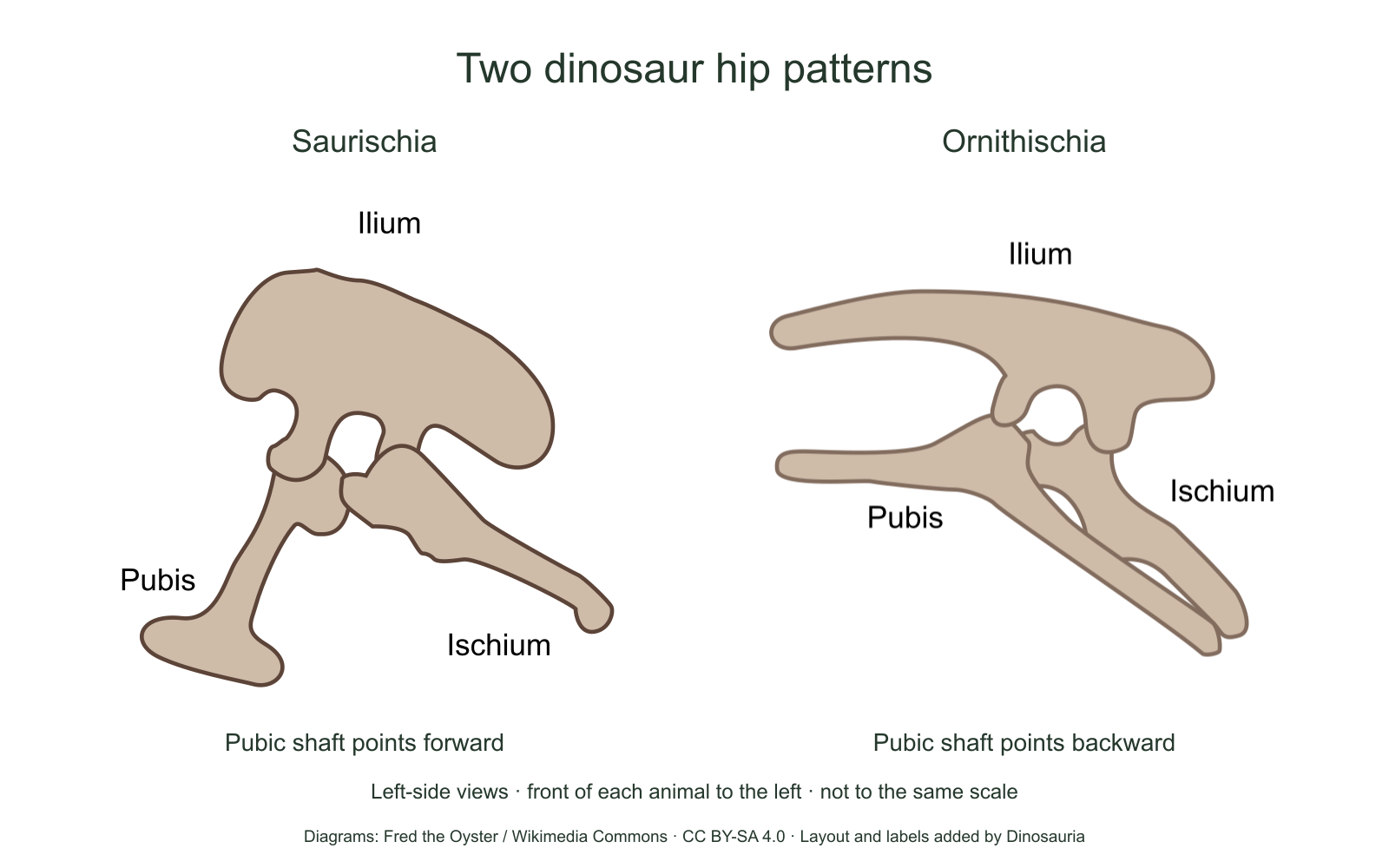
The pelvis links the hindlimbs with the backbone. On each side it includes an ilium above the hip socket and two other bones, the pubis and ischium, extending below it. The orientation of the pubis helped inspire the historical division between saurischians and ornithischians. In the ancestral saurischian arrangement, the pubis projects generally forward. In typical ornithischians, its main shaft points backward alongside the ischium. [2]
This comparison describes a pattern in anatomy, rather than a complete definition of the groups. Skeletons changed after their lineages diverged. Several theropod lineages evolved a backward-directed pubis as well. A later resemblance does not relocate those animals into Ornithischia. Group membership follows ancestry, and scientists test that ancestry using many features distributed across the skeleton. [2]
Saurischia includes contrasting animals
Under the traditional arrangement, Saurischia unites Theropoda and Sauropodomorpha. Theropods include Tyrannosaurus, Allosaurus, Velociraptor and birds. Their variety goes beyond large meat eaters. Across theropod history, different lineages evolved specialized feeding systems, feathers and, on the bird branch, the combination of features that supports modern avian life. A name for an evolutionary group is not a dietary instruction. [3]
Sauropodomorpha includes early forms as well as the long-necked sauropods, such as Diplodocus and Apatosaurus. Adult sauropods were four-legged plant eaters, often with enormous bodies and relatively small heads. Putting them beside theropods shows why visible similarity can mislead. A sauropod and a predatory theropod can share a more recent common ancestor than either does with a horned dinosaur, despite their different proportions and feeding habits. [3]
Ornithischia includes many plant eaters
Ornithischians include armoured dinosaurs such as Stegosaurus and Ankylosaurus, horned dinosaurs such as Triceratops, and ornithopods that include Iguanodon and hadrosaurs. These animals used different combinations of locomotion, food processing, defence and display. Some walked mainly on four legs, while others used two legs or could adopt different postures. Their shared ancestry encompasses much more than one body outline. [1][4]
More than a comparison of diets
It is tempting to simplify the traditional division into meat eaters and plant eaters. Sauropods immediately expose the problem: they were saurischian plant eaters. The predominantly herbivorous ornithischian radiation also contained many different feeding strategies. Teeth, jaws and other fossil evidence inform a diet reconstruction; a branch name alone cannot specify exactly what every member ate. [3][4]
The comparison works better when several questions stay separate. Which group contains the animal? What anatomical evidence supports that position? How did the animal probably feed and move? A useful classification explains relationships, while a reconstruction of its ecology draws on additional evidence. Combining these questions too quickly turns broad patterns into rules with avoidable exceptions.
Why birds are not ornithischians
The name Ornithischia refers to a historical comparison of hip shapes. It does not identify the ancestors of birds. Birds belong within Theropoda, supported by a large suite of shared skeletal features and feathered fossil relatives. The backward orientation of the pubis in birds and ornithischians does not override the rest of that evidence. Similar traits can arise independently in different lineages, a process called convergence. [1][5]
Think of an evolutionary label as a family membership that persists through change. A bird did not leave its theropod ancestry when it acquired a toothless beak, a shortened tail or a distinctive pelvis. The same principle applies to other nested groups: a bird is an archosaur and a dinosaur as well as a bird. Each name describes a different extent of the same ancestry.
The deepest branches are still debated
The classic Saurischia–Ornithischia split remains a useful introduction, but the earliest arrangement of the major dinosaur lineages is an active research question. In 2017, one influential analysis grouped theropods with ornithischians in Ornithoscelida, rather than with sauropodomorphs. This alternative changes the relationships near the base of Dinosauria and the way some traditional names would apply. [6]
A subsequent re-evaluation showed how changes to anatomical scoring and analysis could alter the result, emphasizing uncertainty in this part of the tree. The lesson is not that every dinosaur relationship is equally doubtful. Birds remain nested among theropods in these competing arrangements. The disagreement concerns particular early branching events, for which fossils and anatomical interpretation are especially challenging. [7]
Using the comparison in Dinosauria
Start with the three large lineages: theropods, sauropodomorphs and ornithischians. Then ask how a particular tree connects them. In a traditional arrangement, the first two sit together within Saurischia. That statement describes the displayed hypothesis; it should not be mistaken for a claim that every alternative has been ruled out.
As you follow a branch, use familiar examples to keep your bearings. Triceratops leads into the ornithischian radiation. Diplodocus leads into sauropods. A living bird leads into theropods. Once ancestry becomes the organizing idea, the hip names become helpful historical signposts rather than a trap. Their value lies in opening the family tree to closer inspection.
Continue exploring
- What Is a Dinosaur?
- The Dinosaur Family Tree: Understanding Dinosaur Evolution
- Did Birds Evolve from Dinosaurs?
- The Rise of Tyrannosaurs
- When Did Dinosaurs Live? The Triassic, Jurassic and Cretaceous Explained
- Dinosauria Glossary
- How Did Dinosaurs Get So Big?
- Velociraptor and Its Relatives: Beyond Jurassic Park
- How Do We Know What Dinosaurs Looked Like?
- Why Did Dinosaurs Go Extinct?
Sources & further reading
- AMNH. Know Your Ornithischian Dinosaurs. 2018. (American Museum of Natural History)
- Western Australian Museum. Dinosaur Types. (Western Australian Museum)
- AMNH. Saurischian Dinosaur Fossils. (American Museum of Natural History)
- National Park Service. Major Groups of Dinosaurs. (National Park Service)
- Brusatte et al. 2015. The Origin and Diversification of Birds. (Current Biology (2015))
- Baron, Norman and Barrett. 2017. A new hypothesis of dinosaur relationships and early dinosaur evolution. (Nature (2017))
- Langer et al. 2017. Untangling the dinosaur family tree. (Nature (2017))