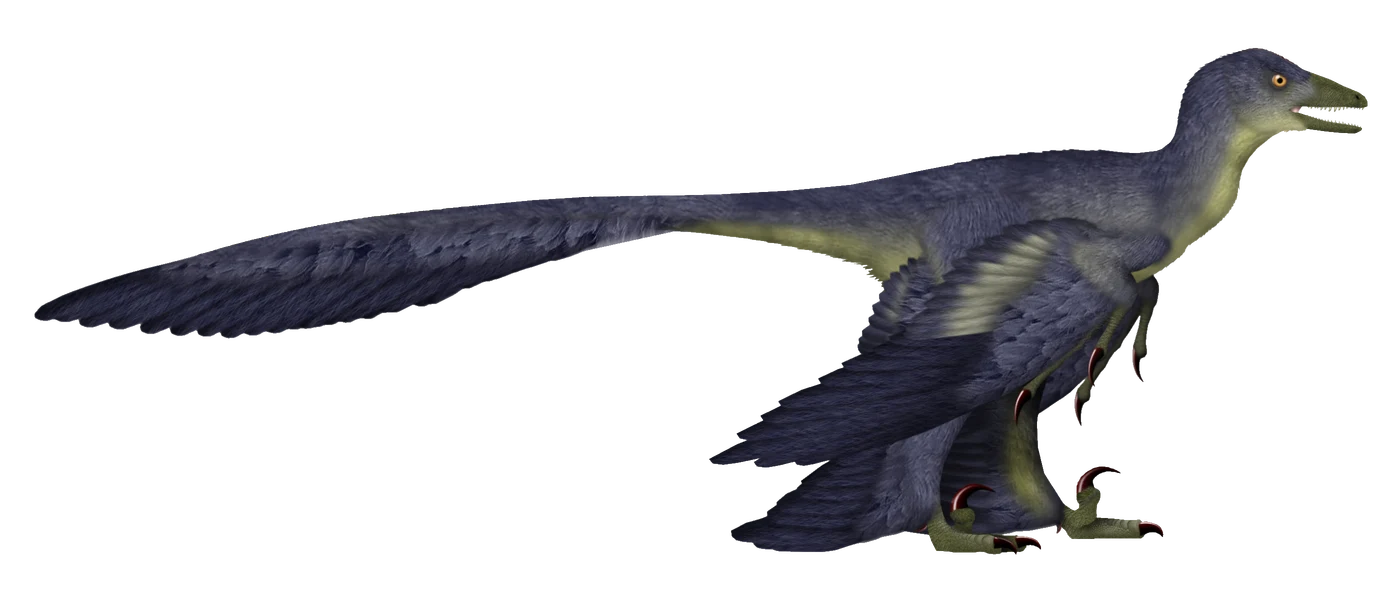
No. Some dinosaurs had feathers, many preserve scaly skin, and a few preserve more than one kind of body covering. Feathers are best documented among theropods, the branch that includes living birds. Feather-like structures also occur in a few fossils from a separate branch, Ornithischia. For most dinosaur species, we have little or no fossil evidence of what covered their bodies. [1][2]
How can a fossil show feathers?
Look closely at the rock around an Archaeopteryx skeleton. The outlines of its wing and tail feathers are still visible. Other fossils preserve simpler structures. In Sinosauropteryx, fine filaments trace parts of the back and tail, giving researchers a different kind of evidence for a feathery covering. [3][4]
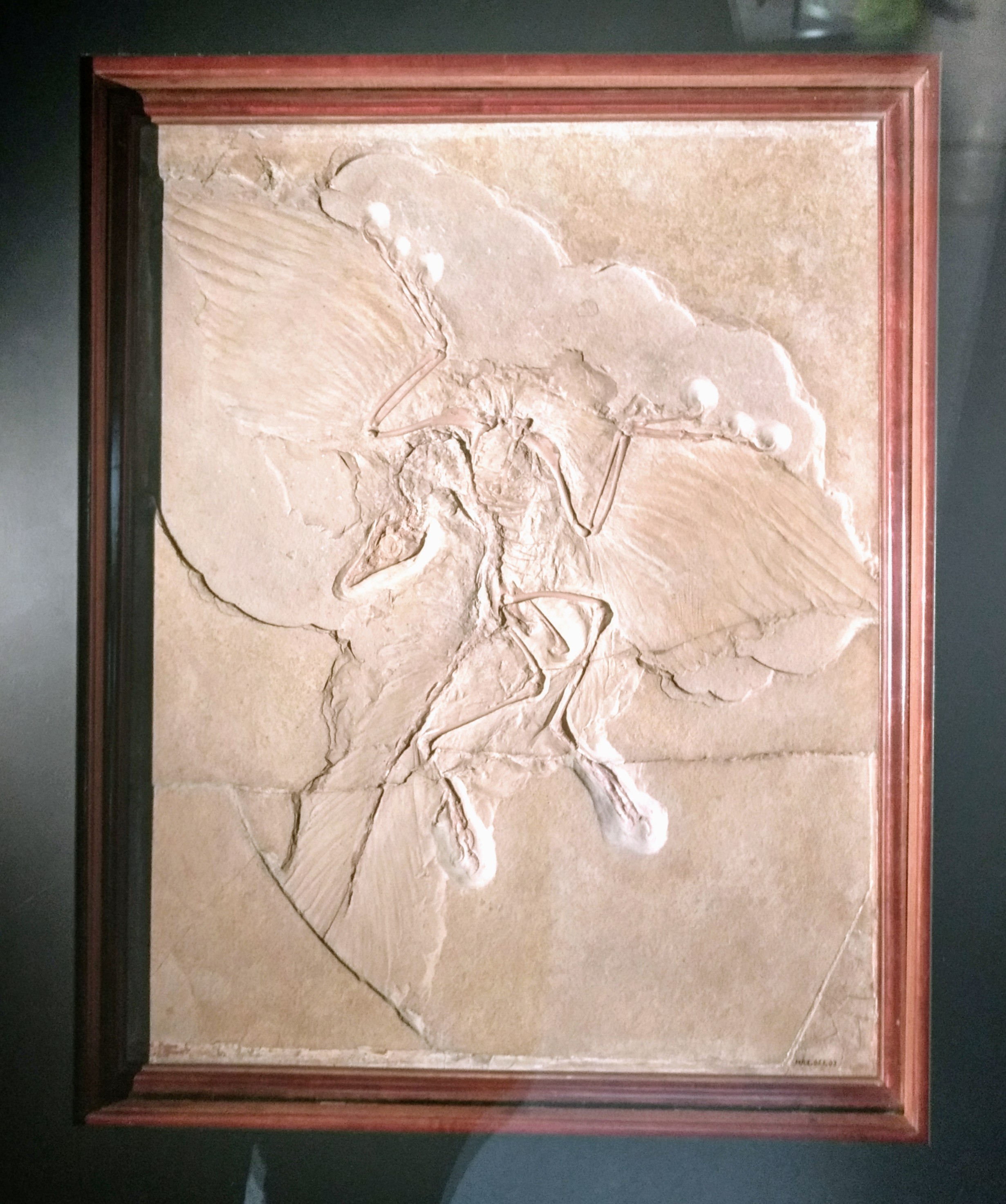
Image: Shyamal, via Wikimedia Commons · CC BY-SA 3.0. Unedited.
A bone can hold a clue even when the feathers themselves are gone. On a Velociraptor forearm, researchers found a row of small bumps called quill knobs. Similar bumps in living birds mark where large feathers attach. The fossil gives us strong evidence for long forearm feathers on Velociraptor, while leaving their colours and much of its body covering open to interpretation. [5]
Skin and feathers usually decay before they can fossilize. A bare-looking skeleton may simply have lost its soft tissues. See How Do We Know What Dinosaurs Looked Like? for more ways researchers piece together an animal’s appearance. [1][3]
Did T. rex have feathers?
One earlier tyrannosaur relative certainly did. Fossils of Yutyrannus from Early Cretaceous China preserve long, simple filaments in several areas across three specimens. It was a large, flightless predator. Its fossils show that even a giant theropod could have extensive feathering. [6]
Tyrannosaurus rex leaves a different record. Skin impressions preserve small scales on parts of its neck, hip and tail. The patches give us direct evidence for scales in those areas. Whether T. rex had sparse feathers elsewhere or at a different age remains open. The rise of tyrannosaurs puts both animals on the same family tree. [7]
Could one dinosaur have scales and fuzz?
Kulindadromeus, a small Jurassic plant eater from Siberia, preserves scales on its tail and lower legs, along with simple filaments and more complex feather-like structures elsewhere. The combination shows why a single patch of scaly skin can tell only part of the story. Sauropods, the long-necked dinosaurs, also preserve scaly skin in multiple species. [1][2]
Kulindadromeus belonged to Ornithischia, a branch well away from the theropods that gave rise to birds. Its fossils raise a question about ancestry. Did those structures and theropod feathers come from a shared ancestor, or did similar coverings evolve independently? The answer depends in part on which fossil structures share an evolutionary origin, and analyses can reach different conclusions. [1][2][8]
What were feathers for before flight?
Feathery coverings occur in dinosaurs that lived entirely on the ground. A coat of filaments could have trapped insulating air, while conspicuous feathers could have helped animals signal to one another. These are plausible uses. Pinning down the original function from the fossil record is harder. [3][6]
On the branch leading to birds, feathers with broad vanes eventually became part of the flight apparatus. Living birds still show how varied feathers can be. The soft down that holds warm air close to the skin and the stiff feathers that form a wing have very different jobs. Follow that branch in Did Birds Evolve from Dinosaurs?. [3]
Read the evidence one fossil at a time
Start with the body part the fossil actually preserves. The Velociraptor forearm tells us where some feathers attached. The T. rex impressions tell us what parts of the skin looked like. Kulindadromeus shows how much the answer can change when a fossil preserves several regions of the same animal. [2][5][7]
Then compare branches. On the dinosaur family tree, find Velociraptor and birds within the theropods, and trace Kulindadromeus back to Ornithischia. The distance between those branches is what makes the Siberian fossils so interesting. The anatomy and ancestry in What Is a Dinosaur? explain why animals with such different coverings still belong to the same family. [1][2]
Explore these taxa in the tree
Continue exploring
- What Is a Dinosaur?
- The Dinosaur Family Tree: Understanding Dinosaur Evolution
- Saurischia vs Ornithischia
- Did Birds Evolve from Dinosaurs?
- The Rise of Tyrannosaurs
- When Did Dinosaurs Live? The Triassic, Jurassic and Cretaceous Explained
- Dinosauria Glossary
- How Did Dinosaurs Get So Big?
- Velociraptor and Its Relatives: Beyond Jurassic Park
- How Do We Know What Dinosaurs Looked Like?
- Why Did Dinosaurs Go Extinct?
Sources & further reading
- Barrett, Evans & Campione (2015). Evolution of dinosaur epidermal structures. (Biology Letters)
- Godefroit et al. (2014). A Jurassic ornithischian dinosaur from Siberia with both feathers and scales. (Science)
- Xu & Barrett (2025). The origin and early evolution of feathers: implications, uncertainties and future prospects. (Biology Letters)
- Smithwick et al. (2017). Re-examining filament evidence in Sinosauropteryx. (Palaeontology)
- Turner, Makovicky & Norell (2007). Feather quill knobs in the dinosaur Velociraptor. (Science)
- Xu et al. (2012). A gigantic feathered dinosaur from the Lower Cretaceous of China. (Nature)
- Bell et al. (2017). Tyrannosauroid integument reveals conflicting patterns of gigantism and feather evolution. (Biology Letters)
- Cockx, Benton & Keating (2026). Estimating ancestral states of complex characters: a case study on the evolution of feathers. (Systematic Biology)