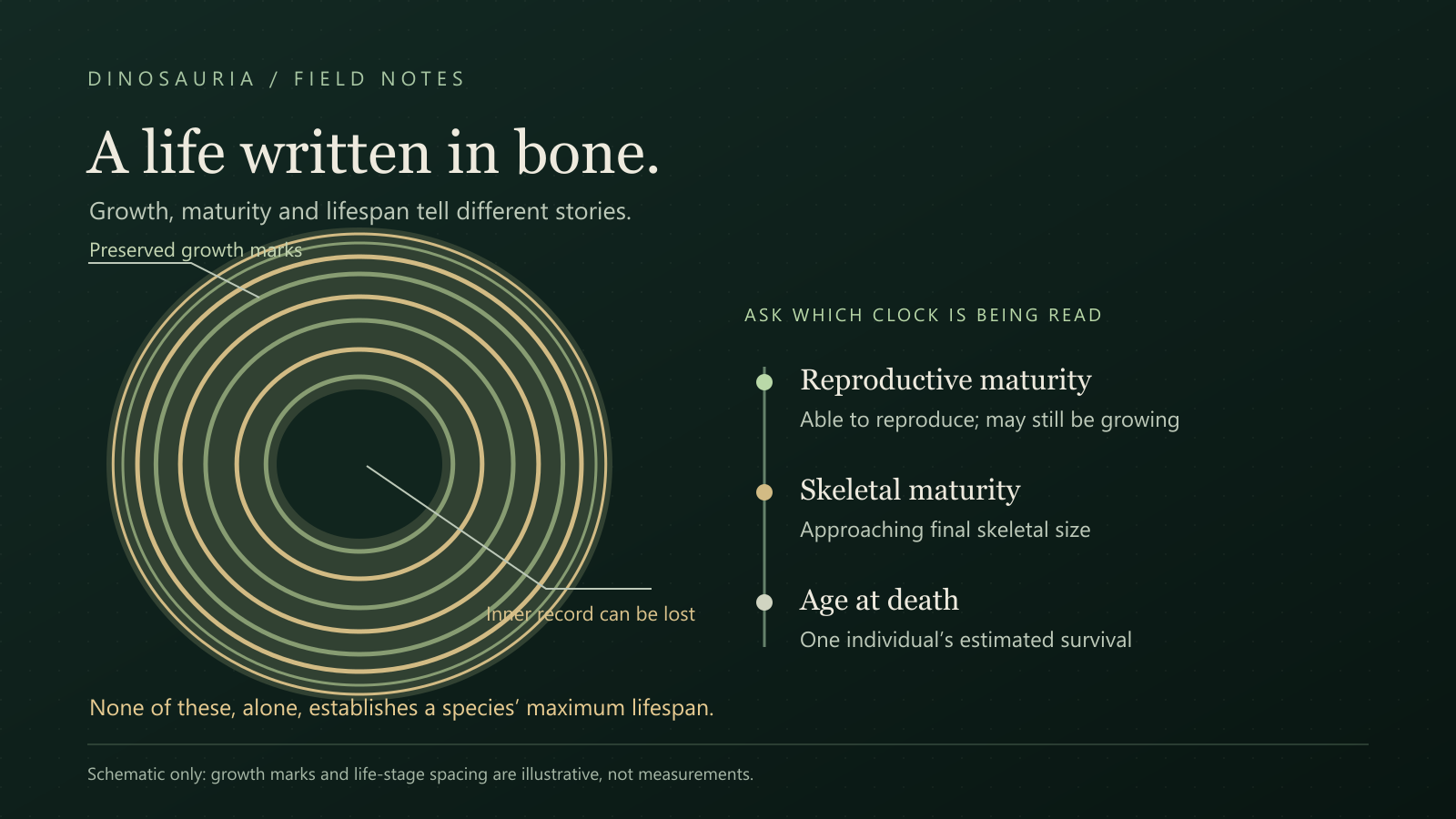
There was no single dinosaur lifespan. Different species followed different growth schedules, and a fossil’s estimated age at death does not reveal the longest life its species could achieve. Bone studies show that some large dinosaurs survived for decades. They do not support giving every dinosaur the same number of years. [1][3]
This article follows the life of an individual animal, from hatching through growth and death. For the millions of years occupied by dinosaur history, read When Did Dinosaurs Live?. Keeping those clocks separate is the first step toward understanding what a fossil age really means.
Four ages that should not be confused
Age at death is the estimated number of years an individual survived. Reproductive maturity is the stage when it could reproduce. Skeletal maturity marks a substantial slowing or near-completion of skeletal growth. Maximum lifespan is the upper limit of survival for the species. These quantities answer different questions. [2][4]
Consider a hypothetical dinosaur that could reproduce at ten, approached adult size at twenty and died at twenty-five. None of those numbers alone tells us the maximum lifespan of its species. Likewise, the oldest individual in a small fossil sample may fall well short of the oldest animal that ever lived.
Average survival is another question. If many hatchlings died young, average life expectancy from hatching could be low even when some adults survived for decades. A number quoted without its meaning can make the very same species sound either remarkably short-lived or impressively long-lived.
How scientists read the record inside a bone
Bone histology studies microscopic tissue structure. Researchers traditionally cut and polish a thin section of fossil bone, then examine it with a microscope. Tissue organization and blood-vessel spaces reveal how bone was deposited; growth marks can record intervals of slower growth or pauses. A line of arrested growth is commonly abbreviated LAG. [1]
Repeated marks are often interpreted as annual cycles, giving a starting point for estimating age. But a bone is living tissue during an animal’s life, and its record changes as it grows. Expansion of the marrow cavity can remove early layers, while remodelling replaces older tissue. A count of visible lines can therefore miss years. Growth marks can also form irregularly, so each visible line is not automatically a separate birthday. [5]
The useful comparison with tree rings has limits. Fossil researchers must establish what the marks mean in that tissue, decide which belong to a single growth cycle and estimate missing early growth where possible. The result is an interpretation with assumptions, rather than a date printed inside a bone.
A slow-growing skeleton is not an animal at the end of life
One important clue is an external fundamental system: closely spaced growth marks in a slowly deposited outer region of bone. It indicates that growth had slowed strongly as the animal approached its final skeletal size. That is useful evidence of skeletal maturity, but it is not a universal marker of imminent death. [2]
Reproduction can begin earlier. Research on medullary bone, a temporary tissue associated with eggshell production in living birds, has supported reproductive activity in some dinosaurs that were still growing. Such evidence shows an animal was reproductively active by its estimated age; it does not necessarily pinpoint the first year it became capable of breeding. [4]
This is why “adult” needs context. An animal can be reproductively mature while continuing to add substantial body mass. Comparing ages between species only makes sense when the studies are measuring the same milestone.
How old could T. rex get?
Tyrannosaurus rex provides a well-studied example, but its growth history is still being revised. A 2020 analysis of a large specimen reconstructed an age at death of roughly 27–33 years and skeletal maturity around 16–22 years, depending on the model. Those estimates helped support the familiar picture of T. rex reaching large adult size in about two decades and surviving for roughly three decades. They were estimates for sampled animals, rather than a proven species-wide ceiling. [3]
A 2026 study by Woodward, Myhrvold and Horner examined an expanded histological sample and alternative ways of interpreting growth marks. Its best-supported model placed the approach to asymptotic body size at about 35–40 years, substantially later than older growth curves. The authors also emphasized a prolonged subadult stage. This is a proposed growth schedule, not a measured average lifespan or proof that forty was the maximum age. [6]
The contrast shows why new sampling and modelling matter. Decisions about marks, missing growth and which specimens belong in a comparison can shift reconstructed ages. A careful account gives the older estimates and the newer result with their methods attached, instead of presenting either as a stopwatch reading.
Maiasaura: growing up was different from surviving
A 2015 study of fifty Maiasaura shin bones reconstructed growth and survival in a duck-billed dinosaur. The authors inferred possible reproductive maturity around the third year and skeletal maturity after about eight years. The reproductive timing was an inference from changes in growth and other evidence, not direct observation of the first breeding season. [7]
The same analysis inferred high mortality early in life, a period of better survival among younger animals that had passed that danger, and rising mortality again in older age classes. Eight years was a growth milestone, not a rule that every Maiasaura died at eight. The survival estimates describe this fossil sample under the study’s assumptions. They should not be transferred wholesale to all duck-billed dinosaurs. [7]
Did giant sauropods live for centuries?
A long neck and enormous body do not establish a centuries-long life. Sauropod histology indicates rapid growth, with the available growth records suggesting that full size could be reached in less than four decades. Some individuals clearly survived beyond their fastest-growing years, but the upper limits of longevity are much harder to establish. [8]
Statements that a giant dinosaur must have lived for 200 or 300 years should therefore be treated cautiously unless they identify a particular specimen, its evidence and the method used. Size alone is not an age estimate. How Did Dinosaurs Get So Big? explores how rapid growth contributed to gigantism. [8]
Why the answer remains a range of possibilities
A fossil collection is not a census of a living population. Small or fragile bones may be lost, particular environments preserve fossils better than others, and one deposit can capture an unusual event. Scientists need specimens spanning different growth stages to reconstruct a species’ life history. Even then, an exceptionally old individual may never have been preserved. [1]
When you encounter a dinosaur age claim, ask what was measured: visible growth marks, a reconstructed age at death, a maturity threshold or a modelled size plateau. Then ask what is missing. This turns a headline number into an explanation you can evaluate.
Birds are living dinosaurs, as What Is a Dinosaur? explains. Their diversity also reminds us to expect different life histories across the family. Use the dinosaur family tree to compare Tyrannosaurus, Maiasaura and long-necked sauropods. Relationships give the context; each animal’s bones provide the evidence for its own life.
Explore these taxa in the tree
Continue exploring
- What Is a Dinosaur?
- The Dinosaur Family Tree: Understanding Dinosaur Evolution
- Saurischia vs Ornithischia
- Did Birds Evolve from Dinosaurs?
- The Rise of Tyrannosaurs
- When Did Dinosaurs Live? The Triassic, Jurassic and Cretaceous Explained
- Dinosauria Glossary
- How Did Dinosaurs Get So Big?
- Velociraptor and Its Relatives: Beyond Jurassic Park
- How Do We Know What Dinosaurs Looked Like?
- Why Did Dinosaurs Go Extinct?
Sources & further reading
- Growing with dinosaurs: a review of dinosaur reproduction and ontogeny (2025). (Biology Letters)
- Hone, Farke & Wedel (2016). Ontogeny and the fossil record: what, if anything, is an adult dinosaur? (Biology Letters)
- Cullen et al. (2020). Osteohistological analyses reveal diverse strategies of theropod dinosaur body-size evolution. (Proceedings of the Royal Society B)
- Lee & Werning (2008). Sexual maturity in growing dinosaurs does not fit reptilian growth models. (PNAS)
- Osteohistological insight into the growth dynamics of early dinosaurs and their contemporaries (2024). (PLOS ONE)
- Woodward, Myhrvold & Horner (2026). Prolonged growth and extended subadult development in the Tyrannosaurus rex species complex revealed by expanded histological sampling and statistical modeling. (PeerJ)
- Woodward et al. (2015). Maiasaura, a model organism for extinct vertebrate population biology: a large sample statistical assessment of growth dynamics and survivorship. (Paleobiology)
- Sander et al. (2011). Biology of the sauropod dinosaurs: the evolution of gigantism. (Biological Reviews)