A selection of the newest names
Some of the latest formally named dinosaurs include Paludohadros proudlovii, Rinconraptor pipoae, Invictibellatrix amberina, Infernogallus jamesi and Norellraptor barsboldi. Their descriptions appeared in September and October 2026. This is a selection of recent non-avian dinosaur species verified as of November 4, 2026, rather than an exhaustive worldwide list or a claim that any one is definitively the newest. New papers can appear between research updates. [1][3][5][7][9]
Here, “latest” means recently described and named in scientific publications. It does not mean the fossils were all dug up this year, or that these animals lived later than other dinosaurs. Finding a bone, recognising a new species, publishing its name and announcing it to the public are separate events. Dates below refer to online publication where available, with fieldwork and museum history identified separately.
Paludohadros proudlovii: a new name from a Surrey brickworks
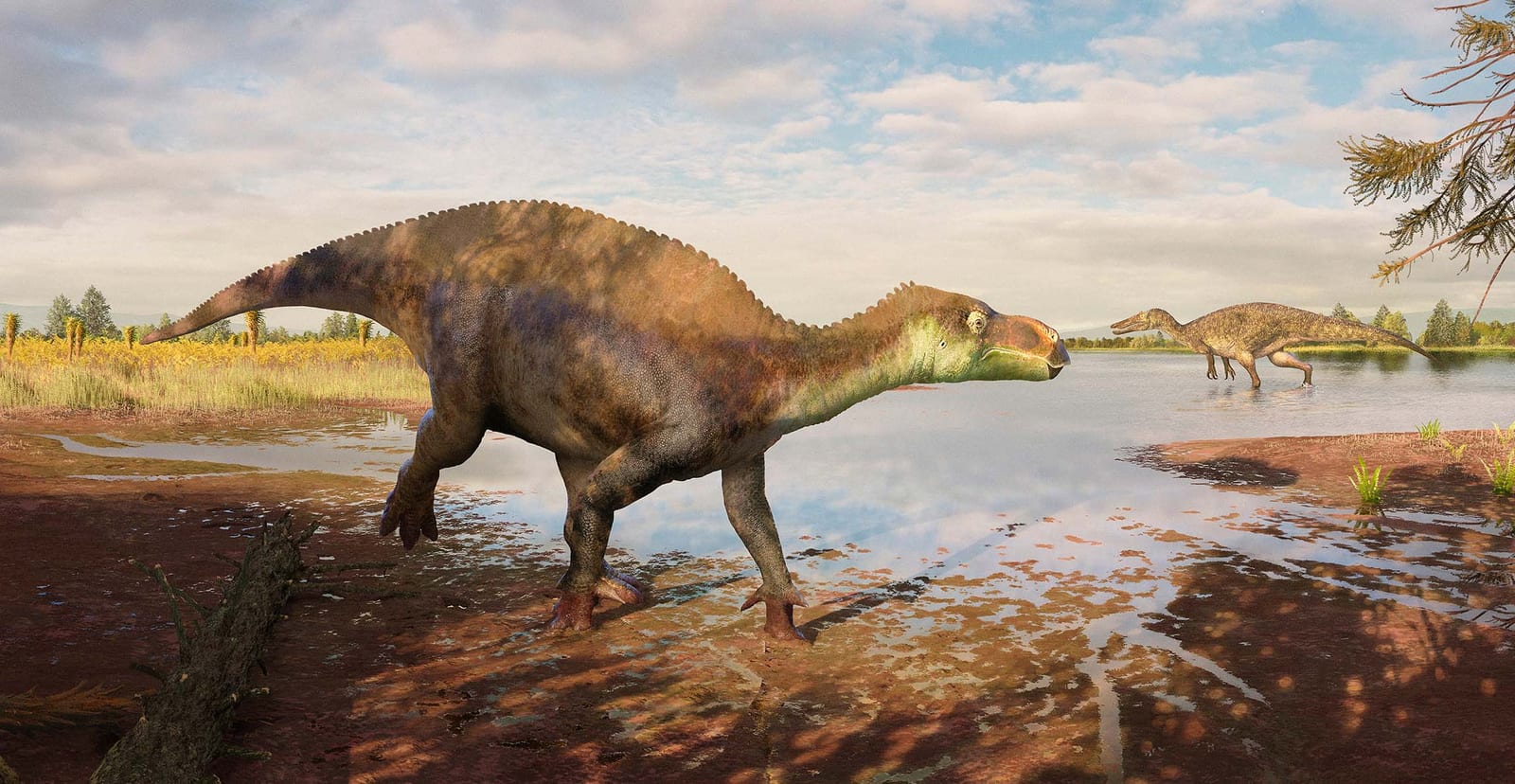
Formally named online: October 26, 2026, in the Journal of Systematic Palaeontology; the Natural History Museum announcement followed on October 27. Fossils were excavated in 2001 at Smokejacks Brickworks, now Ewhurst Works, in Surrey, southern England. The dinosaur lived around 125 million years ago, during the Early Cretaceous, in the landscape recorded by the Weald Clay Formation. The long interval between excavation and naming is central to this discovery. [1][2]
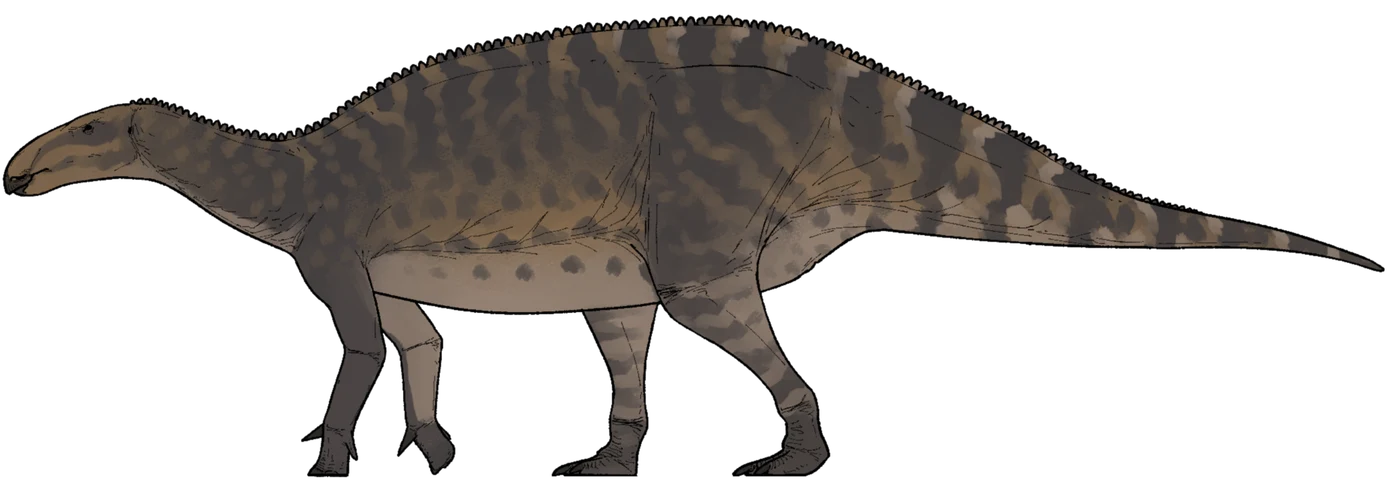
Image: Connor Ashbridge, via Wikimedia Commons · CC BY 4.0. Resized where necessary and converted to WebP; full composition retained.
Paludohadros is an iguanodontian and an early-diverging hadrosauroid: it belongs on the broader branch containing the later duck-billed dinosaurs. Researchers distinguished it using a combination of features in the teeth, lower jaw, arm, pelvis and shin. Its description adds a distinct animal to a region whose plant eaters were historically often assigned to familiar genera. A shared general body shape can conceal meaningful anatomical differences. [1]
The museum estimates that the preserved individual was about five metres long and still immature, so that length is not a secure adult maximum. The species name honours Will Proudlove, the works manager who died before the excavation. The fossils were found near the Baryonyx discovery site, but that proximity does not establish that this particular herbivore was its prey. [2]
Rinconraptor pipoae: another recent predator from Patagonia
Formally described: October 2026, in Palaeontologia Electronica. The journal page identifies the publication month; this article does not substitute its September acceptance date or the November 3 CONICET announcement for the naming date. The fossils come from Cerro Overo, near Rincón de los Sauces in Neuquén Province, Argentina, in the Santonian-age Bajo de la Carpa Formation of the Late Cretaceous. CONICET places the animal around 86 million years ago. [3][4]
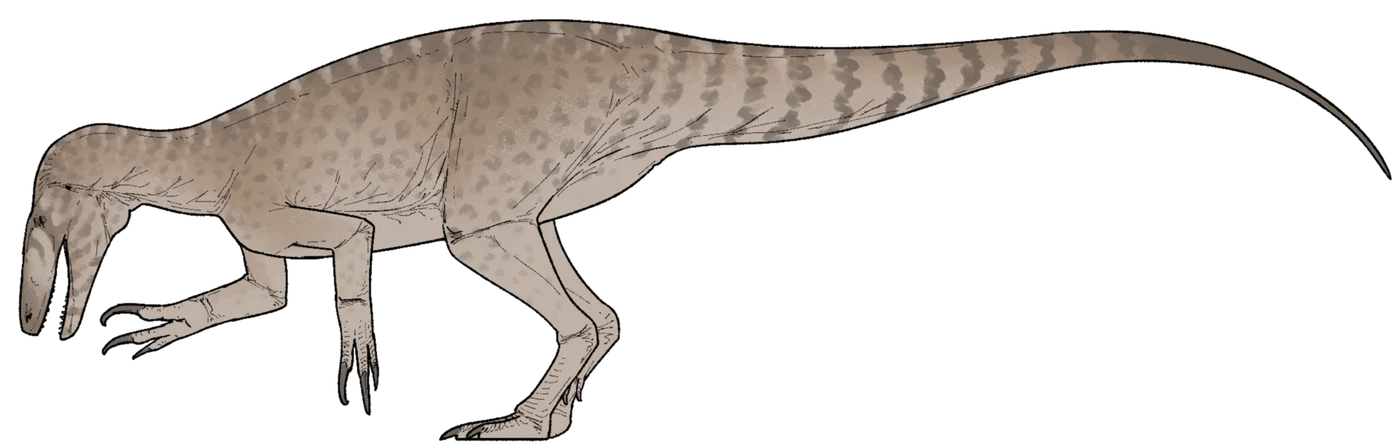
Image: Connor Ashbridge, via Wikimedia Commons · CC BY 4.0. Resized where necessary and converted to WebP; full composition retained.
Rinconraptor was a megaraptorid theropod, estimated by the research team at roughly seven metres long. The naming specimen includes ten tail vertebral centres and parts of an upper arm, shin and chevron. Distinctive arm and shin features support its recognition as a new species. Those remains are a partial skeleton, so a complete body reconstruction depends on comparisons with relatives. [3][4]
The paper reports collecting campaigns in 2014, 2015, 2019, 2023 and 2025 for the material studied as a whole. CONICET specifically connects the new species to the November 2019 expedition and Laura Pipo, a participant honoured by the name pipoae. The authors recover a South American megaraptorid subgroup and discuss similarities with tyrannosauroids. That is a relationship hypothesis, rather than evidence that Rinconraptor was a species of Tyrannosaurus. [3][4]
Invictibellatrix amberina: a museum braincase changes the map
Formally published online: October 14, 2026, in Royal Society Open Science. The fossil was already acquired by the Natural History Museum in 1924, following collection by Reginald Walter Hooley on the Isle of Wight. Acquisition is not an excavation date: the museum announcement does not establish the exact day or year the fossil was found. It comes from the Early Cretaceous Wessex Formation, roughly 120 million years ago. [5][6]
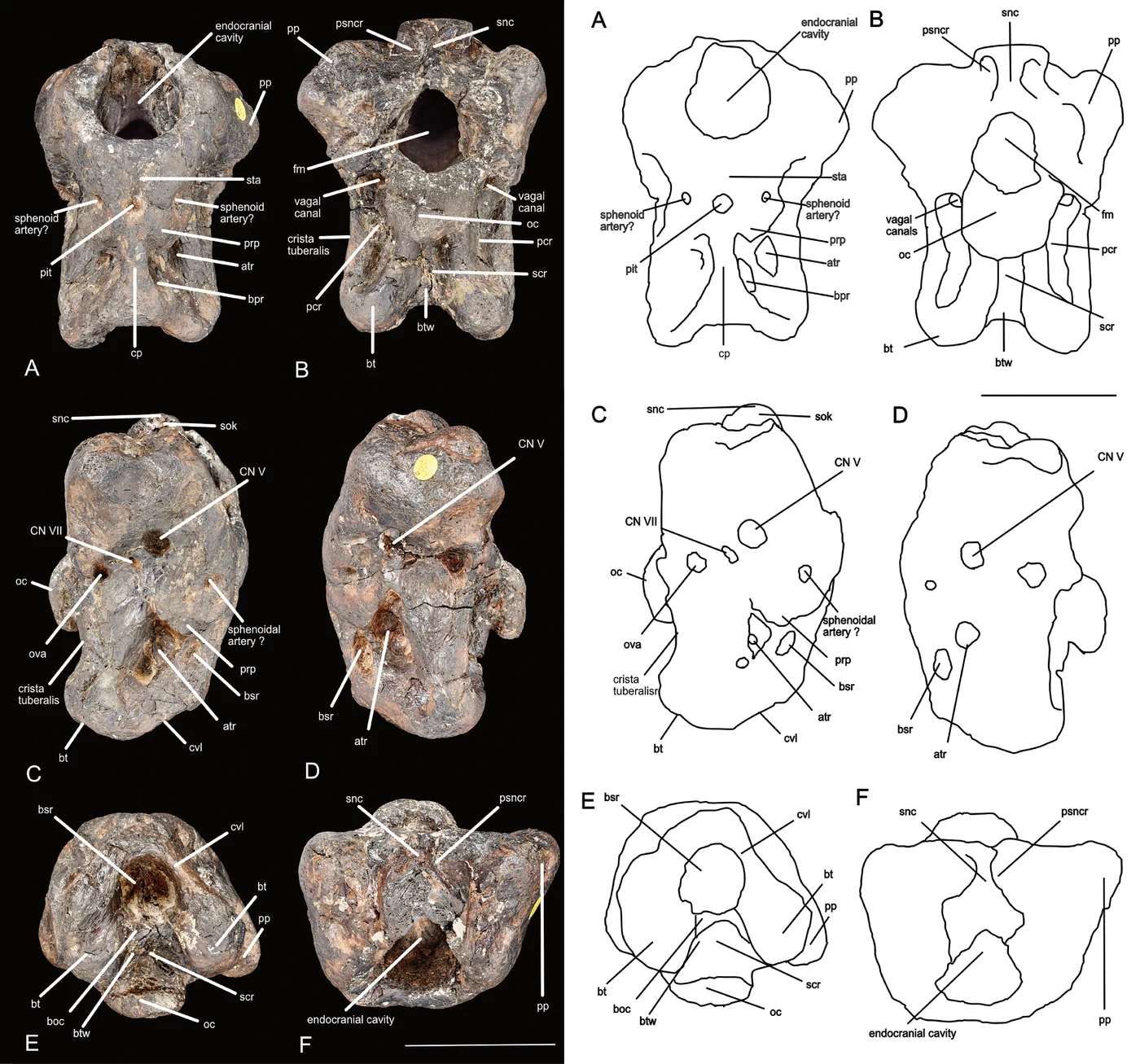
Image: Morrison et al., via Wikimedia Commons · CC BY 4.0. Resized where necessary and converted to WebP; full composition retained.
The specimen is a braincase, the part of the skull surrounding the brain. Its anatomical features and the authors’ evolutionary analyses identify a megaraptoran, the first described from Europe. This matters because it extends the documented geographical range of a group better known from other continents. The paper places it outside Megaraptoridae, the more restricted family containing Rinconraptor, although the details of megaraptoran relationships remain debated. [5]
Large arms and curved hand claws are characteristic of its relatives. The museum’s estimated three-to-four-metre body length and likely appearance rely on comparison: the named specimen does not preserve those limbs or a whole body. A small piece of skull can carry useful evidence about ancestry without preserving every feature shown in a life restoration. [6]
Infernogallus jamesi: a possible fruit specialist
Formally published: October 10, 2026, in Nature Communications. The Royal Ontario Museum issued its announcement on October 28, so the later press date should not be used as the naming date. Its fossils come from the Hell Creek Formation in the United States, near the end of the Cretaceous, around 66 million years ago. The museum announcement does not specify an excavation date; the naming publication date alone cannot tell us when it was dug up. [7][8]
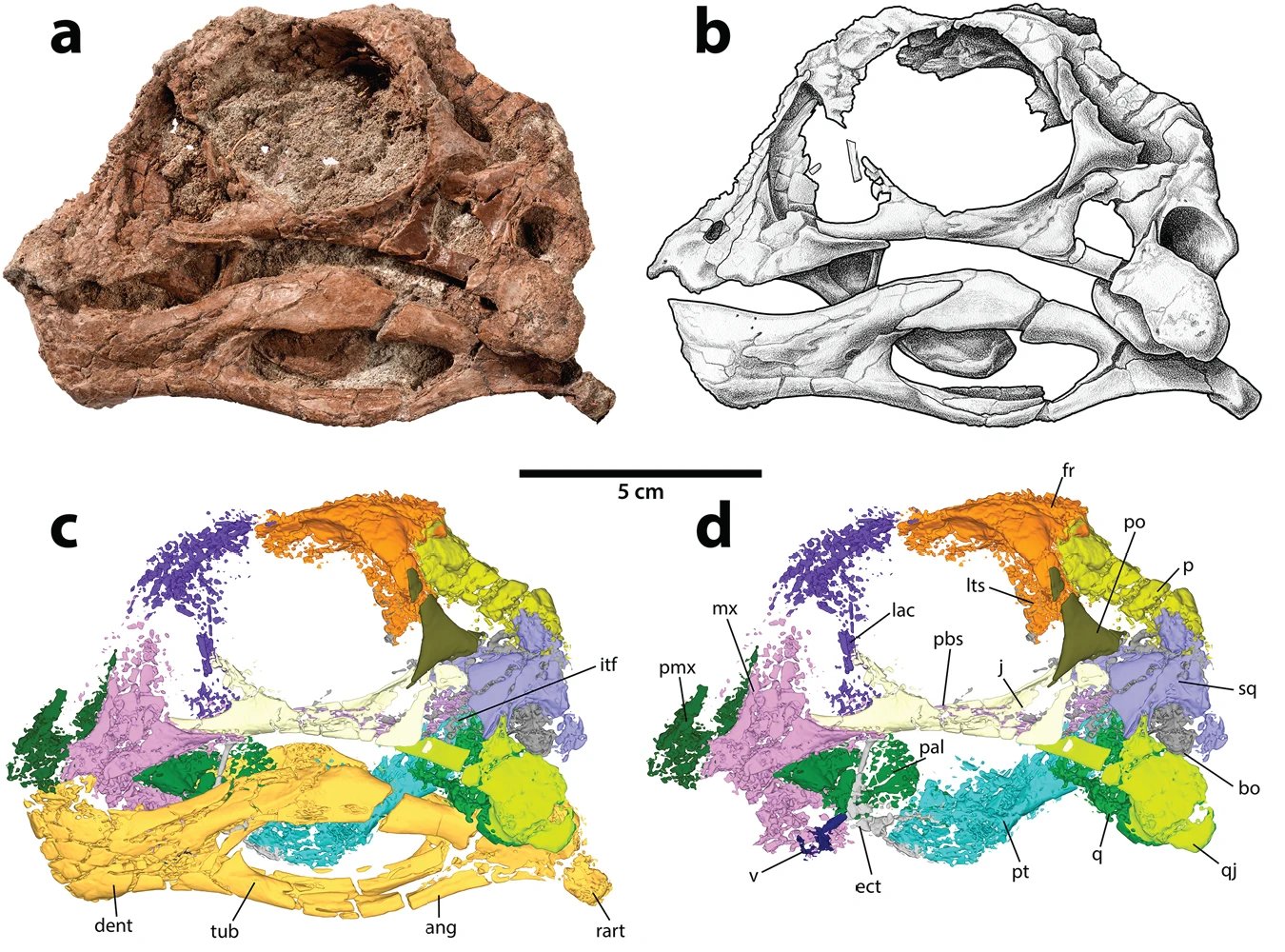
Image: Gregory F. Funston, Thomas W. Dudgeon, D. Jade Simon, Danielle M. Dufault, Clint Boyd, Denver Fowler, Philip J. Currie & David C. Evans, via Wikimedia Commons · CC BY 4.0. Resized where necessary and converted to WebP; full composition retained.
Infernogallus is a small caenagnathid oviraptorosaur, a birdlike theropod with an unusually informative, nearly complete articulated skull. The study reconstructs jaw muscles and proposes a specialised plant-based diet, probably including substantial amounts of fleshy fruit. The anatomy suggests a way of processing soft food by moving the lower jaw backwards and forwards, comparable in some respects to fruit-eating parrots. [7]
This is a functional interpretation of bones and muscle attachments. It should not be read as a preserved menu or proof that every meal was fruit. The importance of the find is the new anatomical evidence for ecological variety among dinosaurs that lived alongside the familiar large herbivores and predators of the latest Cretaceous. [7][8]
Norellraptor barsboldi: feathers and the routes toward flight
Formally published: September 29, 2026, in Nature Communications. The naming specimen is a complete skeleton with preserved plumage impressions from Lamadong, Jianchang County, Liaoning, northeastern China. It comes from the Early Cretaceous Jiufotang Formation, approximately 120 million years old. Its geological age is separate from both its recovery and publication; an excavation year is not established here. [9]
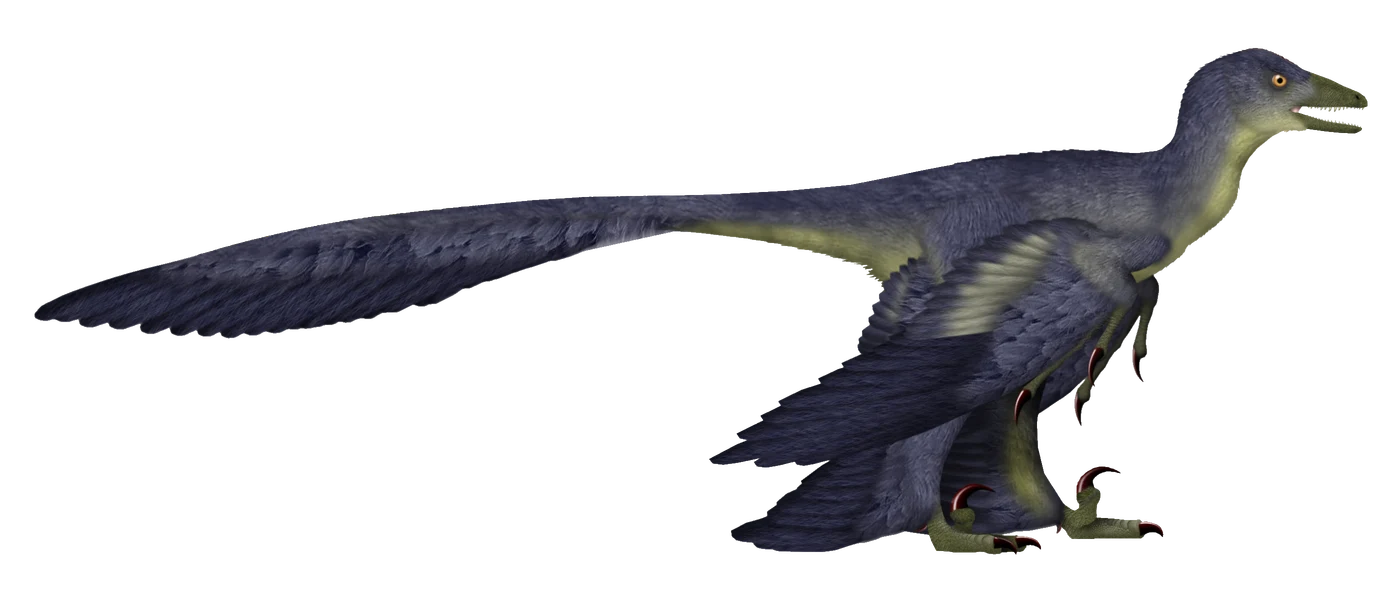
Image: TotalDino, via Wikimedia Commons · CC BY 4.0. Resized where necessary and converted to WebP; full composition retained.
Norellraptor belongs to Microraptorinae within Dromaeosauridae, the wider family that includes Velociraptor. The authors recover it close to Zhongjianosaurus. Feathered limbs and a remarkably complete skeleton help them compare how flight-related structures accumulated in microraptorines and early birds. Similar adaptations appeared in different sequences, supporting independent assembly of flight apparatus in these branches. [9]
That result concerns an evolutionary pattern, rather than a filmed demonstration of this animal’s flight performance. Fossils preserve anatomy; researchers must infer movement from that evidence. For the broader family connection, read Did Birds Evolve from Dinosaurs? and Velociraptor and Its Relatives.
How to read the next discovery headline
Check whether a report concerns a formally named species, an unnamed skeleton still under study, or a new specimen of a species already known. Then look for three different dates: the animal’s geological age, the fossil’s collection history and the scientific publication. Museum announcements help explain discoveries, while the original description records the specimen and anatomical comparisons underpinning the name.
Keep relationships separate from age. A new name can reveal an older branch or improve our view of a younger ecosystem. Use What Is a Dinosaur? for membership in the group, When Did Dinosaurs Live? for geological context, and The Dinosaur Family Tree for reading evolutionary relationships. The tree links below lead to existing comparison groups or relatives, rather than entries for these newly named species.
Explore these taxa in the tree
Continue exploring
- What Is a Dinosaur?
- The Dinosaur Family Tree: Understanding Dinosaur Evolution
- Saurischia vs Ornithischia
- Did Birds Evolve from Dinosaurs?
- The Rise of Tyrannosaurs
- When Did Dinosaurs Live? The Triassic, Jurassic and Cretaceous Explained
- Dinosauria Glossary
- How Did Dinosaurs Get So Big?
- Velociraptor and Its Relatives: Beyond Jurassic Park
- How Do We Know What Dinosaurs Looked Like?
- Why Did Dinosaurs Go Extinct?
Sources & further reading
- Sacamoto et al. (2026). A new iguanodontian dinosaur from the Weald Clay Formation (Lower Cretaceous) of Smokejacks Brickworks, southern England. Published online October 26. (Journal of Systematic Palaeontology)
- New UK dinosaur discovered using Natural History Museum’s fossil collections named after devoted dad and husband. October 27, 2026. (Natural History Museum)
- Méndez et al. (2026). Expanding the dinosaur diversity of the Cerro Overo–La Invernada area: a new species and additional megaraptorid remains. October 2026. (Palaeontologia Electronica)
- Un gigante carnívoro que dejó huella: científicos del CENPAT descubrieron una nueva especie de dinosaurio. November 3, 2026 (Spanish). (CONICET–CENPAT)
- Morrison et al. (2026). A new megaraptoran dinosaur from the Lower Cretaceous Wessex Formation, UK, and its implications for theropod evolution and biogeography. Online October 14. (Royal Society Open Science)
- UK dinosaur fossil identified as new long-clawed predator. October 14, 2026. (Natural History Museum)
- Funston et al. (2026). Fruit-eating adaptations in a Late Cretaceous oviraptorosaur (Theropoda). October 10. (Nature Communications)
- Rare fossil discovery reveals new dinosaur species that were specialized fruit-eaters. October 28, 2026. (Royal Ontario Museum)
- Wang et al. (2026). Independent assembly of the flight apparatus in a non-avian dinosaur clade. September 29. (Nature Communications)