Imagine a dinosaur dying beside a river. Its bones might scatter in a flood, weather in the sun or break apart under the feet of other animals. If sand or mud covers some of them quickly, those bones have a better chance of surviving. Groundwater may later deposit minerals inside them while the sediment around them hardens into rock. [1][2][3][4]
That is one way a fossil forms. A fossil is preserved evidence of ancient life. It might be a piece of the organism itself, the imprint of a leaf or the trail of footprints an animal left while it was alive. Each preserves a different part of the story. [1]
Death, decay and rapid burial
After death, microbes break down soft tissues, scavengers may pull the body apart, and flowing water can carry bones away. Teeth and bones usually last longer than skin and muscle. Even hard parts can be worn down, broken or dissolved, which is why a single tooth or bone fragment is a much more ordinary find than a complete skeleton. [1][2]
A flood can deposit sand and silt over remains on a riverbank. Fine mud can settle over a carcass at the bottom of a lake. Quick burial limits access by scavengers and shields the remains from weathering. Where little oxygen reaches the buried material, some kinds of decay can slow. Decomposition can still continue underground, and soft tissues usually disappear. [1][2][6]
Sediment builds up and becomes rock
New layers can accumulate during later floods or as sediment settles out of water. The weight above squeezes grains closer together. Minerals deposited from water between the grains can cement them in place. Geologists call the conversion of loose sediment into solid rock lithification. Sand can become sandstone, and fine mud can become mudstone or shale. [3]
The fossil and its surrounding rock are different records. A bone can preserve details of the animal, while the grain size, layering and other fossils nearby help researchers work out where it was buried. A river can carry a bone downstream before depositing it, so the burial site may be some distance from where the animal lived or died. [2][3]
How groundwater changes a buried bone
Bone contains tiny openings. When groundwater flows through them, dissolved substances can come out of solution and form minerals in those spaces. This process is called permineralization. Picture the holes in a sponge filling up while its framework stays in place. A fossilized bone can retain some of its original material along with the minerals that filled its pores. [4]
Replacement happens when original material dissolves and new minerals take its place. These changes can occur together in a single fossil. In favourable conditions, the shape and even some microscopic details survive. Those details can help scientists read the growth record inside bone, as described in How Long Did Dinosaurs Live?. [4]
Impressions, molds and casts
Fine sediment can also hold a shallow impression, such as the veins of a leaf or the outline of a feather. A flattened leaf may leave a thin, dark film rich in carbon. On the Berlin Archaeopteryx slab, delicate feather impressions survive alongside the skeleton. See how researchers use evidence like this in How Do We Know What Dinosaurs Looked Like?. [6]
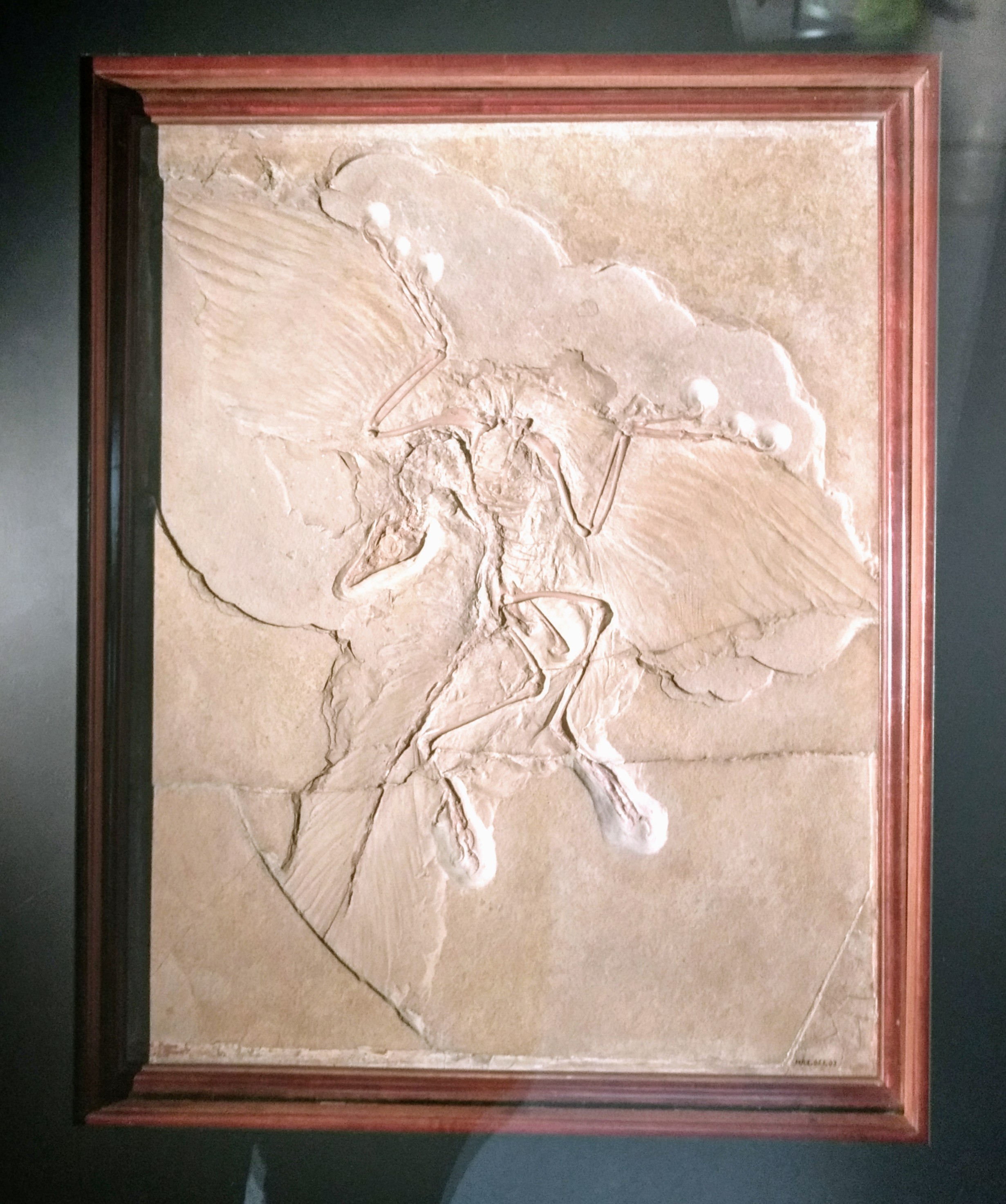
Image: Shyamal, via Wikimedia Commons · CC BY-SA 3.0. Unedited.
A buried shell can dissolve after the sediment around it has firmed up. The hollow left behind is a mold. If sediment or minerals fill that hollow and harden, they form a natural cast that reproduces the shell’s shape. [5]
Some fossils preserve original tissues by other routes. For example, tree resin can trap a small insect and harden into amber. Under suitable conditions, the amber can preserve details such as wings or hairs. [7]
Footprints preserve behaviour
A dinosaur walking over wet sediment can leave a track. If another layer covers the print before waves, rain or trampling erase it, the layers can harden and preserve its shape. The original surface can retain a hollow print, and the layer that filled it can preserve a raised cast. [1][5]
Footprints, burrows and fossil droppings are trace fossils. A set of tracks can show which way an animal was travelling and how widely it spaced its steps. The shape of a print also depends on the firmness of the ground, so the tracks often tell us more about movement than the exact species that made them. [1][8][12]
From buried rock to the excavation site
Fossil-bearing layers can remain underground for millions of years. Movement of Earth’s crust can lift or tilt them. Weathering breaks exposed rock down, and erosion carries away that material. A river can cut into a hillside and reveal a fossil in the rock. The same processes can break the fossil apart if it stays exposed. [2][11]
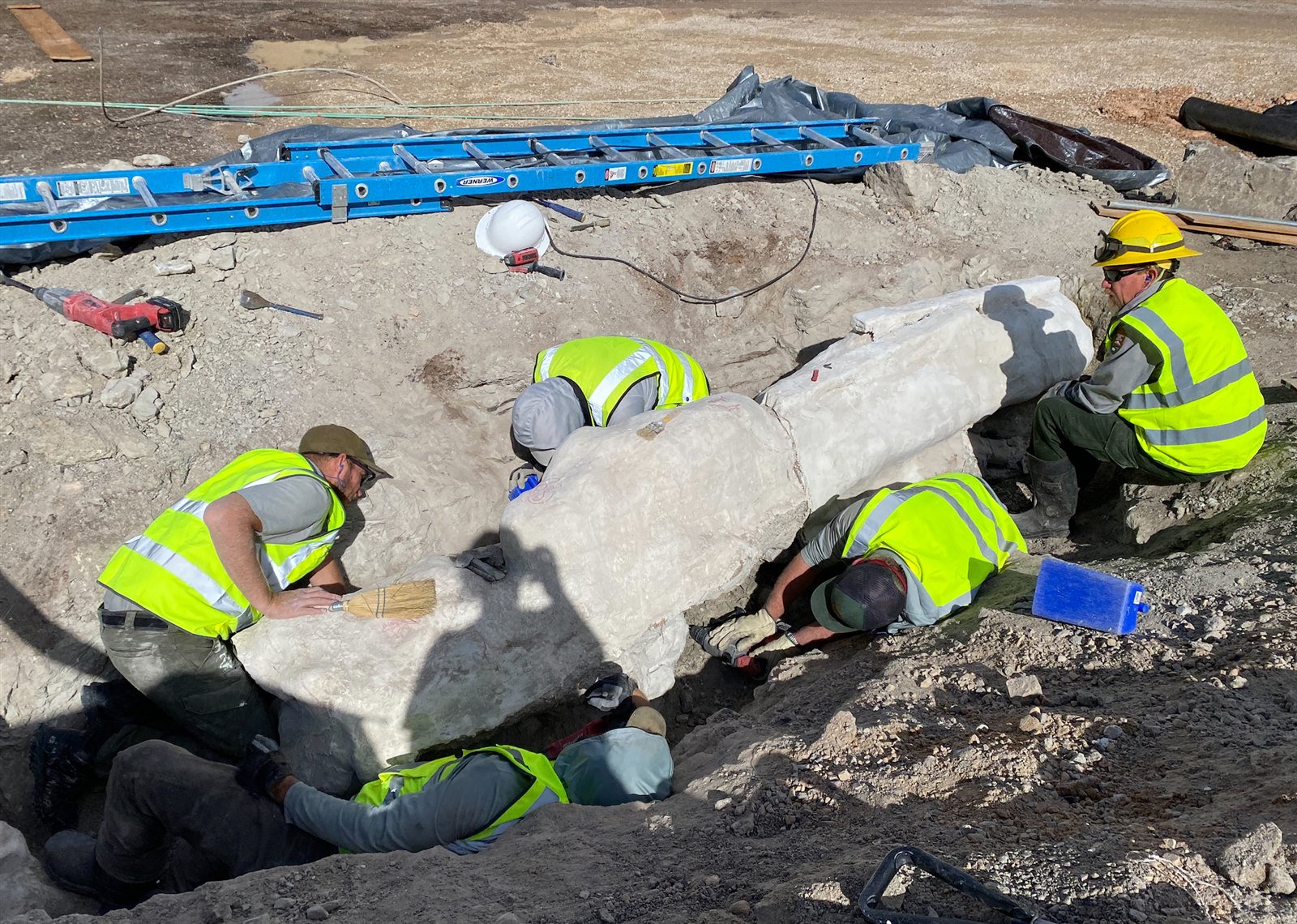
When paleontologists excavate a fossil, they record its position, rock layer and relationship to nearby finds. A large or fragile specimen can travel to the lab inside a block of surrounding rock wrapped in a plaster jacket. Preparators then remove the remaining rock a little at a time. The field notes and photos preserve relationships that would be lost once the specimen was moved. [9][10]
Why fossilization is rare
Most organisms are eaten, decay or break apart before their remains can be preserved. Even a fossil that forms can be crushed, dissolved or eroded away. Others are still buried where no one can see them. Environments that regularly collect sediment, such as floodplains and lake bottoms, are better represented in the fossil record than many upland environments. [1][2]
That uneven record shapes what we can learn. What Is a Dinosaur? shows how scientists recognize members of the group from their anatomy. The dinosaur family tree shows how those observations help reconstruct relationships. A bone, a feather impression and a trackway each contribute evidence that the others may never preserve.
Explore these taxa in the tree
Continue exploring
- What Is a Dinosaur?
- The Dinosaur Family Tree: Understanding Dinosaur Evolution
- Saurischia vs Ornithischia
- Did Birds Evolve from Dinosaurs?
- The Rise of Tyrannosaurs
- When Did Dinosaurs Live? The Triassic, Jurassic and Cretaceous Explained
- Dinosauria Glossary
- How Did Dinosaurs Get So Big?
- Velociraptor and Its Relatives: Beyond Jurassic Park
- How Do We Know What Dinosaurs Looked Like?
- Why Did Dinosaurs Go Extinct?
Sources & further reading
- How Fossils Form (National Park Service)
- Taphonomy: Death and Decay (National Park Service)
- Sedimentary Rocks (National Park Service)
- Permineralization and Replacement (National Park Service)
- Molds, Casts, and Steinkerns (National Park Service)
- Impressions and Compressions (including Carbonization) (National Park Service)
- Preserved Remains: Drying, Freezing, Amber, and Natural Asphalt (National Park Service)
- Trace Fossils (National Park Service)
- New Dinosaur Fossils Excavated at Dinosaur National Monument (National Park Service)
- Techniques in the Field (American Museum of Natural History)
- A Fossil’s Journey (National Park Service)
- LIDAR-based characterization and conservation of the first theropod dinosaur trackways from Arkansas, USA (PLOS ONE)