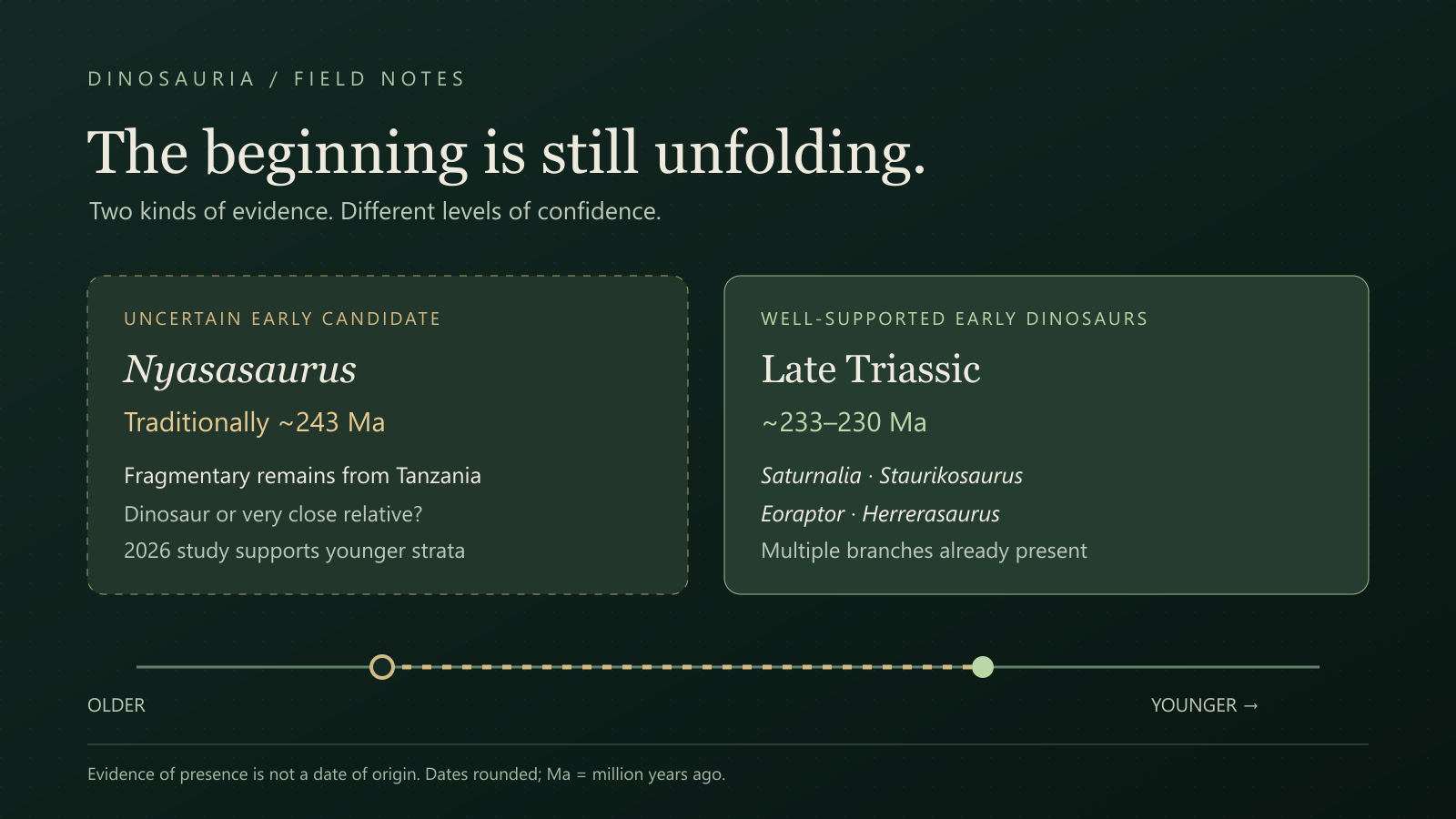
We do not know which species was the first dinosaur. Some of the oldest well-supported dinosaur fossils come from Late Triassic rocks roughly 233–230 million years old. Saturnalia, Staurikosaurus, Eoraptor and Herrerasaurus belong to this early chapter. An older contender, Nyasasaurus, might push the record further back, but its identity and age are less secure. [1][2][3]
That may sound like an unsatisfying answer to a simple question. Yet the uncertainty tells us something useful: the beginning of a family is different from the oldest surviving page of its history. A fossil gives us evidence that an animal existed by a particular time. It rarely tells us where the whole story began.
The oldest known is not necessarily the first
Imagine finding the oldest photograph in a family album. It establishes that those relatives were alive when the picture was taken; it does not identify the family’s first ancestor. Fossils pose a similar problem. An animal had to die in suitable conditions, become buried, survive geological change and eventually be discovered. Most individuals left no accessible record.
Evolution also happens in populations across generations. A new dinosaur lineage did not appear as one unmistakably different hatchling surrounded by completely unrelated parents. Scientists recognize Dinosauria through shared ancestry and combinations of anatomical features. What Is a Dinosaur? explains that membership, while the dinosaur family tree shows how branching relationships are represented.
Even a beautifully preserved early dinosaur need not be a direct ancestor of later species. It can represent a neighbouring branch that split off near the beginning. “Early” describes its place in time; “ancestral” makes a separate claim about descent.
The Late Triassic fossils we can be more confident about
Southern Brazil preserves Saturnalia and Staurikosaurus among its early dinosaurs. A dated horizon in the dinosaur-bearing succession yielded an age of 233.23 ± 0.73 million years. That is why an accessible account often rounds the earliest well-supported record to about 233 million years ago. The uncertainty matters: an age estimate with decimal places is still an estimate, not a birthday for Dinosauria. [2]
Argentina’s Ischigualasto Formation preserves Eoraptor and Herrerasaurus. They are familiar early dinosaurs, but Eoraptor cannot simply be crowned the first. The South American record contains several distinct lineages, and correlations between fossil localities and dated rock layers affect comparisons. The early radiation was already under way when these animals entered the record. [3]
Africa adds an important piece. Mbiresaurus, described from Zimbabwe in 2022, is an early sauropodomorph known from an unusually complete skeleton. Its Late Triassic setting helps connect early dinosaur communities across southern Pangaea. It is a valuable relative of the ancestors of later long-necked giants, rather than a demonstrated ancestor of every dinosaur. [4]
Nyasasaurus: an older possibility with a question mark
Nyasasaurus is known from fragmentary bones from Tanzania, including part of an upper arm and vertebrae. Its 2013 description identified a combination of dinosaur-like features and bone tissue indicating relatively rapid growth. The analysis allowed two important possibilities: an early dinosaur, or a very close relative just outside Dinosauria. [1]
Its rocks have traditionally been assigned to the Middle Triassic, often summarized as about 243 million years ago. That would make it substantially older than the better-established Late Triassic examples. A September 2026 study adds a significant caution: comparisons involving a newly described dicynodont support a younger, late Ladinian to Carnian age for the mid-to-upper Lifua Member of the Manda Beds. This is a correlation between fossil assemblages, not a direct radiometric date on Nyasasaurus. Its precise fossil horizon is also uncertain, so the study cautions against the traditional age rather than establishing a new exact date for that animal. The traditional 243-million-year figure should therefore be treated as provisional. [1][8]
A careful answer therefore calls Nyasasaurus a possible early dinosaur. A more complete skeleton and firmer geological constraints could change its standing. The question mark is part of the evidence, not an invitation to choose whichever answer sounds most dramatic.
Close relatives complicate the starting line
Silesaurids are another reason the answer can change. These Triassic reptiles have often been placed immediately outside Dinosauria. Other analyses place some or all of them along the early ornithischian branch, within the dinosaur family. Under those alternative trees, fossils once described as close dinosaur relatives become evidence of early dinosaurs themselves. [5]
This is not a dispute about whether the bones exist. It concerns which arrangement of relationships best explains their anatomy. Reassigning a fragmentary animal can shift the apparent starting point without anyone finding an older rock. Always read an “oldest dinosaur” claim alongside the family-tree hypothesis it uses. [5]
What newer discoveries and models actually say
In 2025, researchers described Ahvaytum bahndooiveche from Wyoming, using fragmentary hindlimb material and radioisotopic age constraints of about 230 million years. They interpreted it as an early saurischian, probably a sauropodomorph, and the oldest known dinosaur from Laurasia, the northern part of Pangaea. This challenges a simple picture of dinosaurs reaching northern regions much later. It does not identify the first dinosaur worldwide. [6]
A separate 2025 study modelled dinosaur origins while accounting for uneven fossil sampling and alternative evolutionary trees. Many of its models supported an origin in low-latitude Gondwana, rather than only the better-sampled southern regions. This is a prediction about where missing early history may lie. It is not the discovery of a dinosaur skeleton in the Amazon or Sahara. [7]
Those studies tackle different questions: one adds fossil evidence of early northern dinosaurs; the other tests geographical origin scenarios. Together they make the familiar map less certain. Neither supplies a named species that can confidently be called the ancestor of all later dinosaurs.
Putting the beginning into perspective
The first dinosaur chapter belongs to the Triassic, before the Jurassic landscapes associated with Stegosaurus and Diplodocus. Pangaea connected land areas that are widely separated today. Early dinosaur communities included many other reptiles; their later prominence should not be projected back onto every Triassic ecosystem. [2][4]
For the broader sequence, visit When Did Dinosaurs Live?. If your question is how many years one animal survived, How Long Did Dinosaurs Live? follows a different clock: growth recorded inside individual bones.
The strongest answer is a set of contenders with different levels of support. Explore Saturnalia, Herrerasaurus, Eoraptor and Mbiresaurus below, and remember that a cladogram shows relationships. Its branch order and branch lengths do not, by themselves, tell you which fossil is oldest.
Explore these taxa in the tree
Continue exploring
- What Is a Dinosaur?
- The Dinosaur Family Tree: Understanding Dinosaur Evolution
- Saurischia vs Ornithischia
- Did Birds Evolve from Dinosaurs?
- The Rise of Tyrannosaurs
- When Did Dinosaurs Live? The Triassic, Jurassic and Cretaceous Explained
- Dinosauria Glossary
- How Did Dinosaurs Get So Big?
- Velociraptor and Its Relatives: Beyond Jurassic Park
- How Do We Know What Dinosaurs Looked Like?
- Why Did Dinosaurs Go Extinct?
Sources & further reading
- Nesbitt et al. (2013). The oldest dinosaur? A Middle Triassic dinosauriform from Tanzania. (Biology Letters)
- Bernardi et al. (2018). Dinosaur diversification linked with the Carnian Pluvial Episode. (Nature Communications)
- Novas et al. (2021). Review of the fossil record of early dinosaurs from South America, and its phylogenetic implications. (Journal of South American Earth Sciences)
- Griffin et al. (2022). Africa’s oldest dinosaurs reveal early suppression of dinosaur distribution. (Nature)
- Upchurch & Chiarenza (2024). A brief review of non-avian dinosaur biogeography: state-of-the-art and prospectus. (Biology Letters)
- Lovelace et al. (2025). Rethinking dinosaur origins: oldest known equatorial dinosaur-bearing assemblage (mid–late Carnian Popo Agie FM, Wyoming, USA). (Zoological Journal of the Linnean Society)
- Heath et al. (2025). Accounting for sampling heterogeneity suggests a low paleolatitude origin for dinosaurs. (Current Biology)
- George et al. (2026). Craniomandibular osteology of Dinodontosaurus isiyavamanda sp. nov. (Therapsida: Anomodontia) from the Manda Beds of Tanzania and new support for a younger age for the alleged oldest dinosaurs. (Journal of Vertebrate Paleontology)